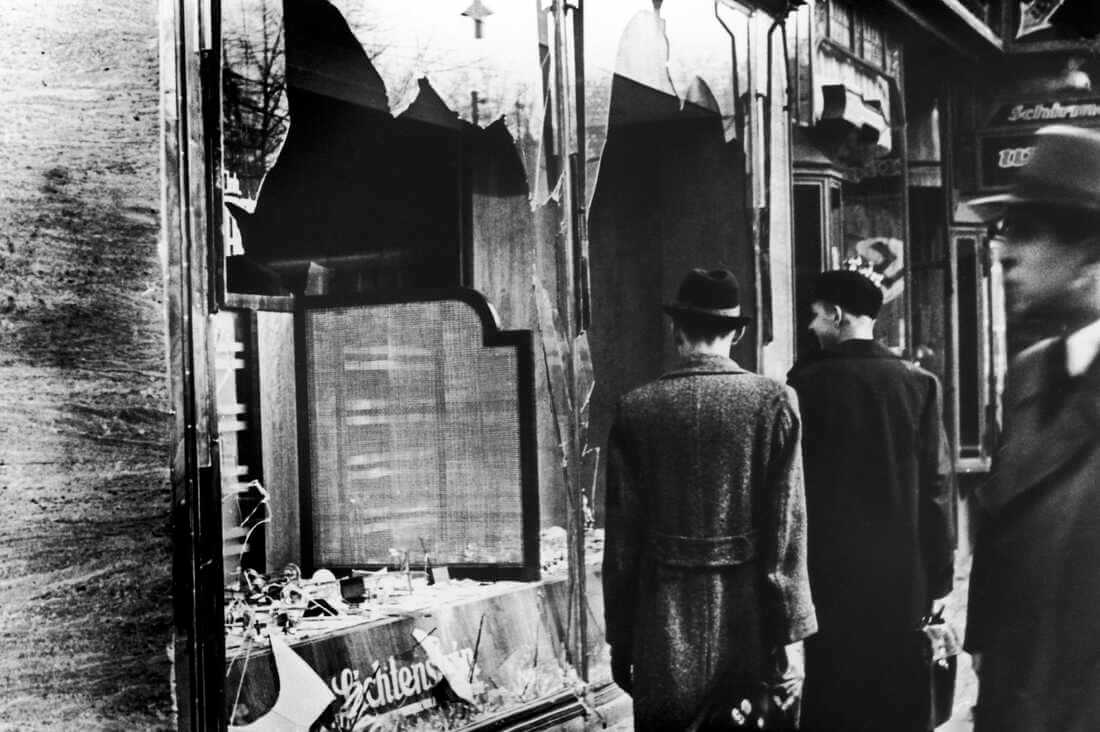
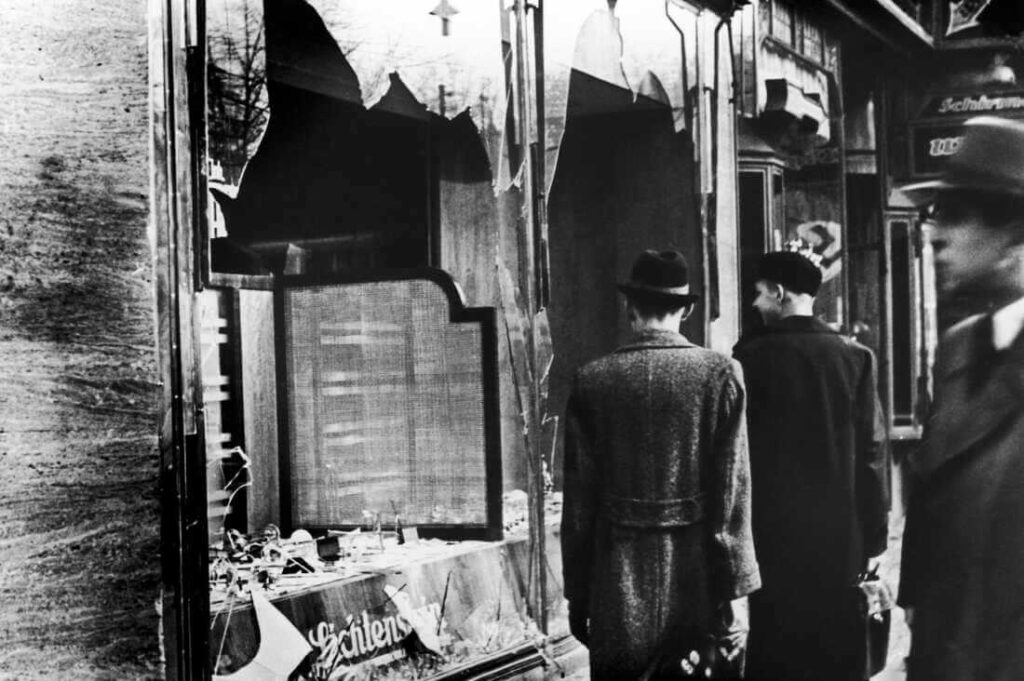
Eighty-five years ago today, Jewish communities in Central Europe awoke to the devastation of Kristallnacht, a seminal moment in history, a point at which words were transformed into actions, and one that has a resounding echo for today.
To mark this significant anniversary the AJR was deeply honoured to welcome His Majesty The King to meet some of the refugees who fled to Britain on the Kindertransport, a unique humanitarian rescue that was instigated in response to the Reichspogrom.
Described by one historian as “the catastrophe before the catastrophe” the magnitude of the horror, inhumanity and tragedy of the pogrom is seared into our consciousness.
Kristallnacht was itself the culmination of a series of tumultuous events started with the Polenaktion, the deportation to the border of Poland and Germany of 17,000 Jews of Polish origin from Germany and Austria that began on 29 October 1938.
Among those who were deported were the parents of Herschel Grynszpan, who was living in Paris. So enraged was Grynszpan at the treatment of his family, who had lived in Germany since before the First World War, that he went to the German embassy in Paris with the aim of assassinating the Ambassador; in his absence Grynszpan shot and killed the diplomat Ernest vom Rath.
Part of the motivation was the desire of Nazi Party leadership, which had gathered in Munich, to mark the anniversary of the 1923 Beer Hall Putsch, the failed coup d’etat, the centenary anniversary of which we also commemorate.
Vom Rath’s assassination was just the excuse the Nazi party needed; the German government unleashed the Reichspogrom – the Night of Broken Glass (Kristallnacht) – a night of anti-Semitic violence throughout Germany, Austria, and the newly occupied Czech-Sudetenland during which over a thousand synagogues and some 7,500 Jewish-owned shops and 29 department stores were ransacked and destroyed; many Jewish cemeteries and schools were vandalized.
Mobs of SA men roamed the streets, attacking Jews in their houses and forcing Jews they encountered to perform acts of public humiliation; some 91 Jews were killed in the streets. Police records of the period document a high number of rapes and of suicides in the aftermath of the violence. Local firefighters received orders to intervene only to prevent flames from spreading to nearby buildings.
Also in the aftermath, 30,000 Jewish men were arrested and deported to places that have since become synonymous with the Holocaust: to Dachau, Buchenwald and Sachsenhausen, and a fine of one billion Reichsmarks was levied against the Jewish community for the cost of cleaning up the devastation.
For the Jewish communities of central Europe, it was the realisation that to the legal and psychological oppression was added violence and physical persecution.
As Abraham Joshua Heschel pointed out: “Speech has power. Words do not fade. What starts out as a sound, ends in a deed.”
But, alongside the devastation, we remember also the response. 85 years ago, in the countries that gave us the Enlightenment; Schiller and Goethe; Mozart and Beethoven, Jewish families were desperately seeking escape routes, and community groups here, including Jews and Quakers, were mobilising to help them.
On 15 November 1938, a delegation from the Council for German Jewry, called on Prime Minister Neville Chamberlain and proposed, among other measures, the admission into Britain of children under the age of 17. The advocates included Chaim Weizmann and Chief Rabbi Joseph Hertz, who declared that Hitler’s regime was, “a government of terror as had never before been seen in a civilised country”.
With organised political pressure on the government mounting, a full-scale debate on refugee policy took place in Parliament on 21 November, instigated and led by the Quaker MP, Philip Noel Baker, which resulted in the Home Secretary, Sir Samuel Hoare, announcing that the Home Office would give entry visas to all child refugees whose maintenance could be guaranteed.
Sir Samuel added: “I could not help thinking what a terrible dilemma it was to the Jewish parents in Germany to have to choose between sending their children to a foreign country, into the unknown, and continuing to live in the terrible conditions to which they are now reduced in Germany.”
Historians have pored over the story of the Kindertransport but, immediately following the debate, the Herculean effort to prepare the transports took just ten days to organise, with the first train arriving in to Liverpool Street on 2 December. Through this unique act of rescue, some 10,000, mostly Jewish children, were brought to safety with more than half never seeing their parents again.
Remembering these acts and the lives of those who fled and survived, has been part of the AJR’s work and mission since our founding in 1941.
And it is equally as vital today and in this national week of remembrance, but also now to combat increasing Holocaust denial and antisemitism, an effort to which we too contribute through the development of our Refugee Voices and My Story testimony projects and as the leading benefactor of Holocaust education and remembrance projects and programmes.
In remembering this history we also proclaim our warning that Never Again should Jewish communities be subject to terror and persecution.