1 November 2021. A blog post from AJR’s Chief Executive, Michael Newman OBE.
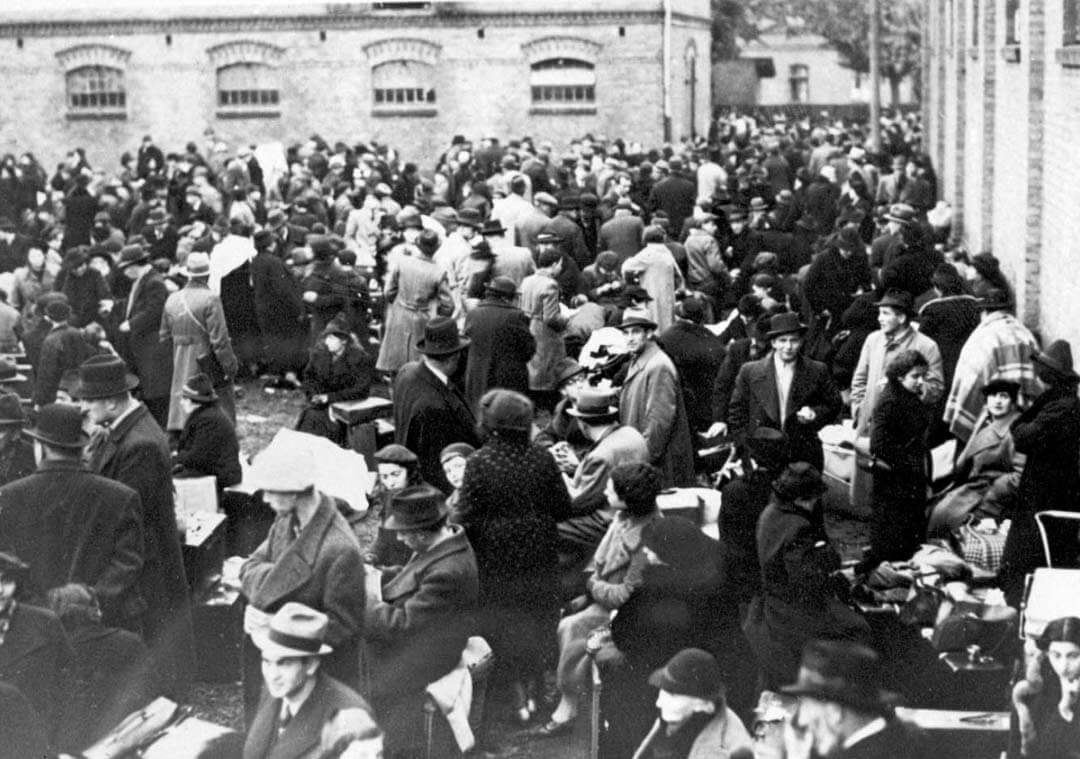
Ahead of our service to commemorate Kristallnacht, I thought I would take a moment to explain the enormity of the tragedy and its impact on Jewish communities living in Central Europe, but also the events that led to it, as today – 29 October – marks the anniversary in 1938 of a key turning point in Nazi policy: the Polenaktion, the deportation of 17,000 Jews of Polish origin from Germany.
Following the Anschluss – Germany’s annexation of Austria – in March 1938, the Polish government became concerned that Jews of Polish origin now living in Austria and Germany would seek to come back to Poland to escape the rising antisemitism. Consequently, the Polish Parliament passed a law making it possible to denationalize Polish citizens who had been living abroad for more than five years uninterrupted. On 9 October 1938, the Polish government decreed that passports issued abroad would only be valid with a special stamp from the Polish consulate.
The German government in turn became concerned that such a move by Poland would impact on its own plans to expel Jews living in Germany, so on 26 October, the German government gave Poland an ultimatum: if it did not rescind its order, Germany would deport the Polish citizens from Germany before the new regulation took effect. Poland did not back down so the order was given to round up and deport 17,000 Jews of Polish origin living throughout Germany, to the Polish-German border, most to the town of Zbaszyn. In some cases it was whole families, in others just males above a certain age.
Included in those who were deported were the parents of Herschel Grynszpan who was living in Paris. So enraged was Grynszpan at the treatment of his family, who had lived in Germany since before the First World War, that he went to the German embassy in Paris with the aim of assassinating the Ambassador; in his absence Grynszpan shot and killed the diplomat Ernest vom Rath. Coincidentally, the Nazi Party leadership were already gathered in Munich to mark the anniversary of the 1923 Beer Hall Putsch, the failed coup d’etat. Hearing of vom Rath’s murder the German government unleashed the Reichspogrom – the Night of Broken Glass (Kristallnacht) – a night of antisemitic violence throughout Germany, Austria, and the newly occupied Czech-Sudetenland during which over a thousand synagogues and some 7,500 Jewish-owned shops and 29 department stores were ransacked and destroyed; many Jewish cemeteries and schools were vandalised.
Mobs of SA men roamed the streets, attacking Jews in their houses and forcing Jews they encountered to perform acts of public humiliation; some 91 Jews were killed in the streets. Police records of the period document a high number of rapes and of suicides in the aftermath of the violence. Local firefighters received orders to intervene only to prevent flames from spreading to nearby buildings.
Also in the aftermath, 30,000 Jewish men were arrested and deported to places that have since become synonymous with the Holocaust: to Dachau, Buchenwald and Sachsenhausen, and a fine of one billion Reichsmarks was levied against the Jewish community for the cost of cleaning up the devastation.
For the impacted Jewish communities the violence of Kristallnacht was also the dawning realisation that their physical safety was in danger alongside the psychological persecution they were enduring through increasing restrictions, and led to the mass emigration of Jews including some 70,000 who found refuge in Britain.
Another of the 17,000 Jews deported to Zbaszyn on 29 October 1938 was my great uncle, Max, who was 21. Although there was initially some correspondence from him, his precise fate – like many other thousands – remains unknown. But there were some survivors from Zbaszyn. Sir Erich Reich, one of our members, whose family were Polish Jews living in Vienna, and his brothers, managed to get from Zbaszyn to Gdansk from where they got a boat to safety in London.
With thanks to the Jewish Museum Berlin for information. Photo: Yad Vashem digital collection 2656/18