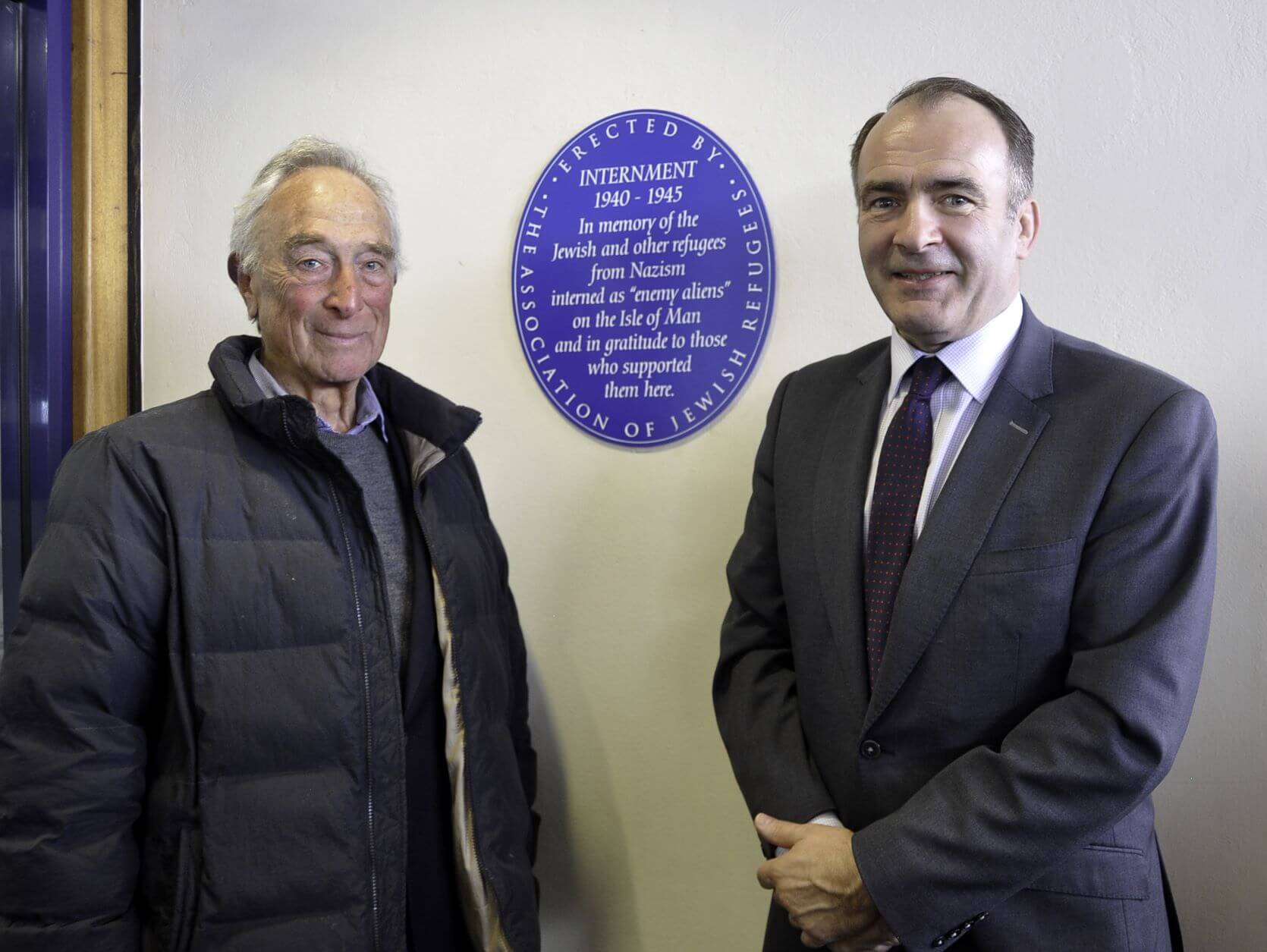
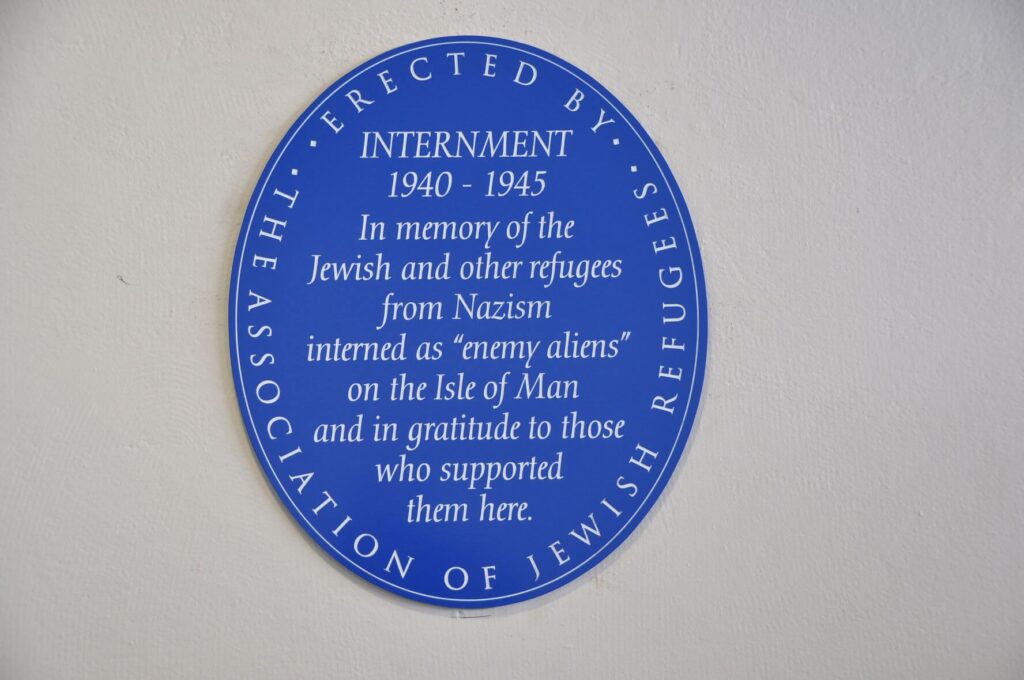
 In May and June 1940, the British government interned almost 30,000 refugees from Nazi Germany and Austria, some 25,000 men and 4,000 women, mostly on the Isle of Man. These internees were predominantly Jewish; they had been classified at the outbreak of war as refugees from Nazi oppression who posed no threat to the security of the United Kingdom. But in 1940, as Hitler’s armies began their advance across western Europe, an unscrupulous campaign was mounted in the right-wing press, portraying the refugees as a potential fifth column of agents for Germany.
On 12 May 1940, the government of newly appointed Prime Minister Winston Churchill commenced the mass internment of enemy aliens; his infamous call to “collar the lot” came three days later. Those detained were mostly held in temporary camps, then transferred to the Isle of Man, where they were accommodated in requisitioned boarding houses. The government also deported some 7,000 refugees to Canada and Australia. But when the SS Arandora Star, en route to Canada, was sunk by a German submarine with heavy loss of life on 2 July, the policy of internment was discontinued. Beginning in August 1940, most were released by mid-1941.
Internment was a disastrous government policy. Not only did it cast the shadow of suspicion on the very community of people most impacted by Nazism, it separated families and caused additional unnecessary displacement. So ill-conceived was the policy that Jewish refugees and Germans with Nazi sympathies were interned together. Internment represented the lowest point in the relations between Britain and the Jewish refugees.
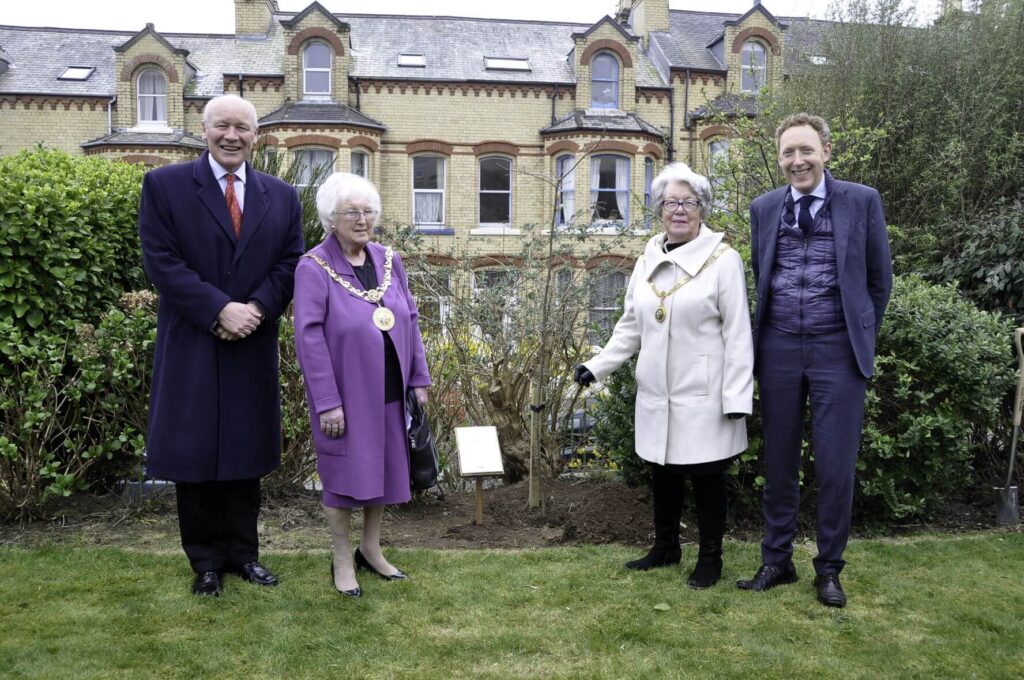
On 28 March 2022, we traveled to the Isle of Man and gathered at Hutchinson Square, the very location where the refugees were given homes and supported by people on the island, to remember this dark history but also the lives of those impacted. And, we all of course had in our minds those fleeing oppression and conflict today. The parallels between the Russian invasion of Ukraine and the Second World War are obvious, but the sight of the refugees fleeing their homes from a murderous neighbour is something we thought was confined to the history of Europe. Unimaginably, those now being displaced include Holocaust survivors who witnessed the Nazi invasion of Ukraine in 1941 and then experienced life under Communist oppression after the war. Indeed, the AJR is now providing our unique support to the first Holocaust survivors from Ukraine who have arrived here.
While many of the internees could not forgive what Victor Cazalet MP, termed a ‘bespattered page’, a senseless and inhumane action against an innocent, defenceless group of people, curiously, many internees subsequently took a conciliatory view of internment. Notwithstanding its deprivations many also recalled a rich cultural time while interned reflecting what Dr Tony Grenville, in his masterly book, Encounters with Albion, called “the wealth of creative, intellectual and academic talent confined there.”
Dr Grenville cites the example of the composer and musicologist Hans Gal, who recalled in his diary, “And who is punishing us? Are these our friends, the same British people who received us in friendly fashion, recognised our work, offered our children their hospitality, gave us the feeling of a new homeland?” As Dr Grenville notes, “Internment undermined the stable core of their identity by placing their loyalty in question and treating them as potential traitors.”
The futility of Internment is reflected in the response to the publication of the White Paper providing the internees’ release, with one British officer noting, “They couldn’t release the lot of you at once, after all the fuss they made over your internment. It would look too silly.”
These reflections are in contrast to interviews given more latterly to our Refugee Voices archive with Kurt Treitel recalling visits from Rabbi Schonfeld to make sure those who wanted it got kosher food for the High holidays, while Walter Brunner remembers, “There was no shortage of food, Isle of Man kippers were very good. We got sick of them because we had them every day. Smoked kippers, you know what they are? And there was nothing wrong, the sun was shining and really if we wouldn’t have been parted from our family it was almost like a holiday camp. I learnt tailoring to make ladies coats and costumes.”
In his interview for our My Story project, Heinz Skyte recalls being more or less left to his own devices inside the camp but that a double fence of barbed wire encircled his accommodation in the Central Promenade Internment Camp in Douglas. He remembers, “We cooked for each other and started arranging activities. There were quite a considerable number of academics, artists and professionals as well as us youngsters. They soon started giving lectures and holding discussions. You could have lectures on almost any subject.” Another interviewee, Suzanne Lee, shared that her father taught Spanish to the other internees and met many interesting people, including the musicians of the Amadeus Quartet, while Edith Whyatt recalls: “My mother and I were in a small boarding house. We had meals provided for us; we hardly noticed we were being interned. My mother was delighted with the situation – she loved the view from the window of the sheep in the green pastures. We would often feed the seagulls our leftover kippers.” She continued, “At that time I had no idea what the future would hold. We had given up our home, I had to cut my studies short, but we were away from the Nazis and that was the main thing. I don’t remember how long we were on the island, but it wasn’t very long. On the whole, our experience felt very much as if we were guests not internees. I, however, would have liked the opportunity to be patriotic for England.”
Internment is also indelibly linked to the foundation of the AJR in July 1941. It was their experiences here that convinced the refugees of the need for their own organisation – for themselves and by themselves – to represent their interests, and maintain their culture and heritage, and address and support the practical needs of their community.
In its formative years the AJR dealt with the settlement of the refugees and the absorption into British life of those who fled. Assisting people with locating missing loved ones, naturalisation and the fight for restitution were key post-war priorities.
Our focus in more recent years is the provision of social welfare services and the sponsoring of educational and commemorative projects. We were delighted to mark our 80th anniversary last year by launching the 80 trees for 80 years project; to plant 80 native oak trees (and one cherry at Oxford) around Britain in honour of people and places that symbolise the enormous contribution made to every walk of British life by the refugees from Nazi oppression.
And through this wonderful project, we have been able to reach new audiences and make new friends throughout the country. It has captured the imaginations of communities the length and breadth of all four parts of the United Kingdom – and now one island – and in places that have a direct connection to this unique history.
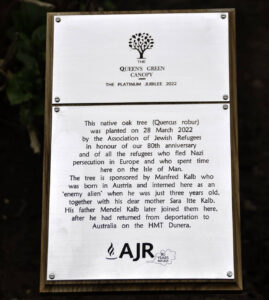 The tree we planted on the Isle of Man honours the family of Manfred (Fred) Kalb who endured displacement and internment. In 1939 Fred’s father, Mendel, managed to escape Nazi oppression in Austria and to come to the Richborough Camp in Sandwich. The following year however, classed as an “enemy alien”, he was sent to Australia on the ill-fated ship Dunera. Despite the torpedoes and the dysentery he survived the 57 day voyage and was transported with the rest of the refugees to New South Wales where they were detained by the Australian government. When the Japanese attacked Pearl Harbour, they were re-classified as “friendly aliens”.
Meanwhile Fred, who was just a small child, was brought to the UK by his mother and the pair of them were interned on the Isle of Man for 18 months. As soon as Mendel was allowed to return to the UK he joined them there and the family was reunited. On release they spent the rest of the war years from in Leicester. Fred, we are grateful to you for sponsoring not just this tree but also a second oak tree, in Sandwich, in honour of your late parents.
The trees are one half of our efforts to commemorate our 80th; the other project is the UK Holocaust Map, a digital resource that similarly marks the places that connect to the Jewish refugees’ story. The trees feature prominently on the map alongside excerpts from the AJR’s Refugee Voices testimony archive and many other collections, all of which aims to show that – just as with this tree – teaching and learning about the Holocaust as well as the Jewish refugee story – can be delivered at this micro level.
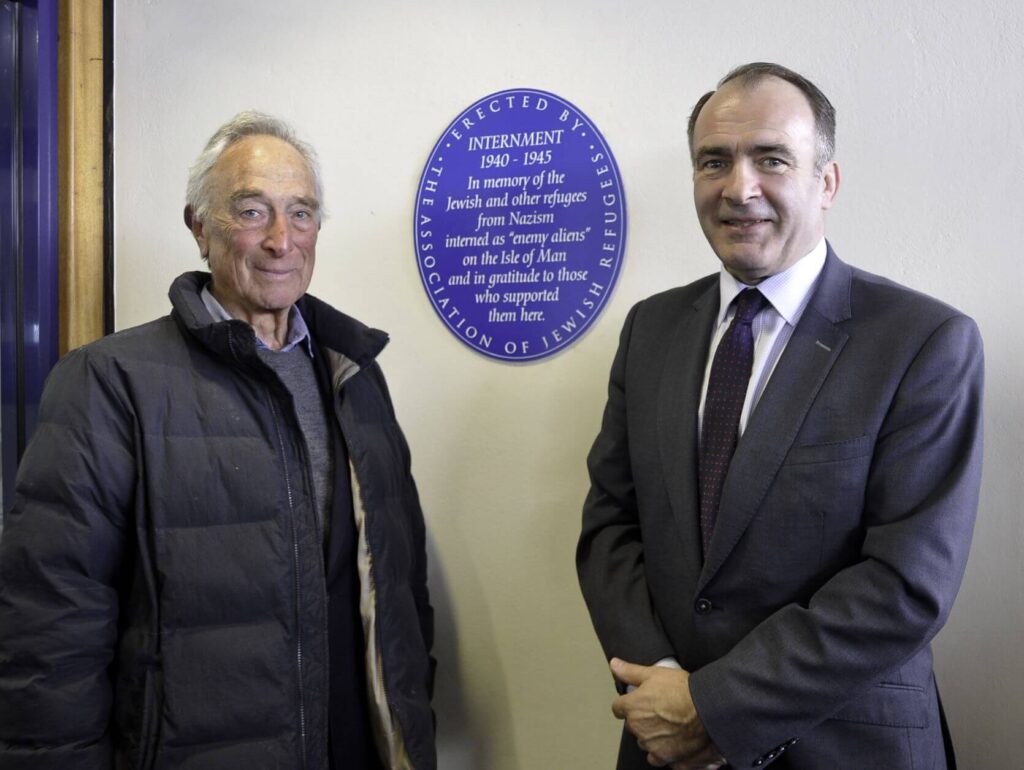
Also featured on the map are the AJR’s blue plaques that honour and commemorate the lives of prominent refugees who made a particularly outstanding contribution to their adopted homeland as well the places and institutions that form part of our heritage. Immediately after this tree planting, we will be unveiling our latest plaque at the port in remembrance of internment.
We would like to also thank our colleagues here on the Isle of Man for their support with our endeavours and also to congratulate Monica Bohm-Duchen at Insiders/Outsiders and Aviva Dautch at Jewish Renaissance on conceiving, persevering and delivering this wonderful trip and for connecting many of the second generation to this compelling history.
But as well as the next generations, being connected to that first generation – of survivors and refugees – has taken on a greater urgency in recent years. We are very fortunate to receive generous funding from the German government exclusively for the welfare and care benefit of that first generation. So, we are eager to be in touch with anyone you know who might now need our help, and others who will help champion our cause.
We are thrilled also that our tree project has been endorsed by the Queen’s Green Canopy and while all trees are unique, this tree helps tell an especially remarkable story and epsiode. It is our fervent hope that this tree will endure and put down its roots in the same way that Manfred, whom we are honouring today, and so many others were able to do so.
Photos credited to Anita H. Grosz