It’s time to celebrate The Queen’s Platinum Jubilee!
“From chocolatiers to coat makers and contributions in all fields of British life, the Jewish refugees have helped nourish, protect and entertain Her Majesty, who embodies the essence and values of their adopted nation. We send our heartiest congratulations on her platinum jubilee and wish her bis hundertzwanzig.”
Below we’ve put together some stories and photos from our members of their memories of Her Majesty.
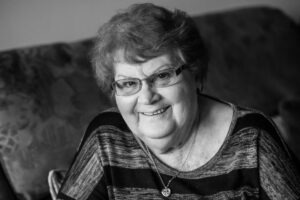 In an extract from her My Story book, Eva Behar remembers, “I was invited to St James’s Palace on the 60th anniversary of liberation, on Yom Hashoah. I went with a group on a coach. We were all lined up in a huge room and we were greeted by stewards with a tray full of minute sandwiches, so tiny I don’t think they were even one mouthful! The Queen and The Duke of Edinburgh entered from the right, which I knew was the throne room. They literally went along from one side, speaking to as many of us as they could, all the way round to the other side, and then out again. When The Queen got to me, she asked: “Why are you here my dear?” I will never forget the way she said “my dear”. I said I had been in Auschwitz and Belsen and been liberated from Belsen. She asked: “Was it horrific?” and I replied: “Ma’am, if you could find a better word than horrific then that’s the one I would use, but I haven’t got one.”
 AJR Refugee Voices have this great image and recollection from Bea Green with The Queen at the opening of the first permanent Holocaust Exhibition at the Imperial War Museum. “She stopped before the occasional bod including me and said: “This is a very important exhibition.” And I said: “Yes, your Majesty, especially for our children.” This was totally unrehearsed. I didn’t know what she was going to say and it didn’t really hit me until, like, a week later that I actually had been addressed by the Queen. But I was glad she was there.”
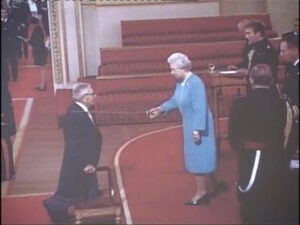 Oscar-winning James Bond set & production designer Ken Adams was knighted by Her Majesty The Queen at Buckingham Palace in 2003.
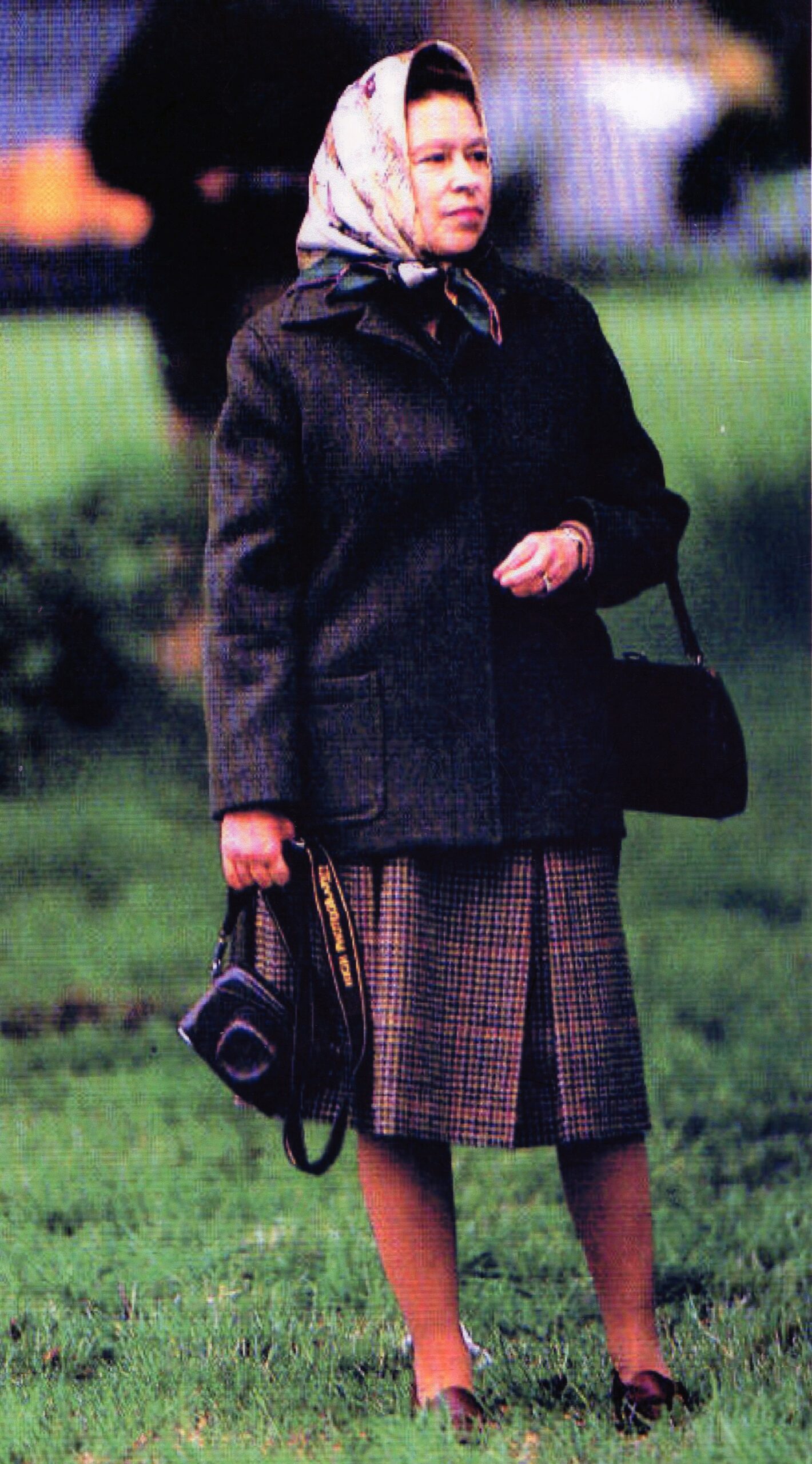 Kurt Wick survived the Holocaust as a young boy in Shanghai. In an extract from his My Story book, Kurt remembers, “We called our business Mondaine Handbags, a name suggested by Sigmund’s girlfriend because it sounded a bit French. There were three others working with my father, brother and me. We started working out of 45 Kilburn High Road before ending up at 306 Kilburn High Road, which was an easy walk from where we lived with our parents. Within a few months, we started supplying some of the top shops in Bond Street and Knightsbridge with our lizard, snake and crocodile-skin handbags. That’s what we made for the next 50 years. I have the proud honour of owning a photograph of the Queen of England carrying one of the bags I made with my own hands.”
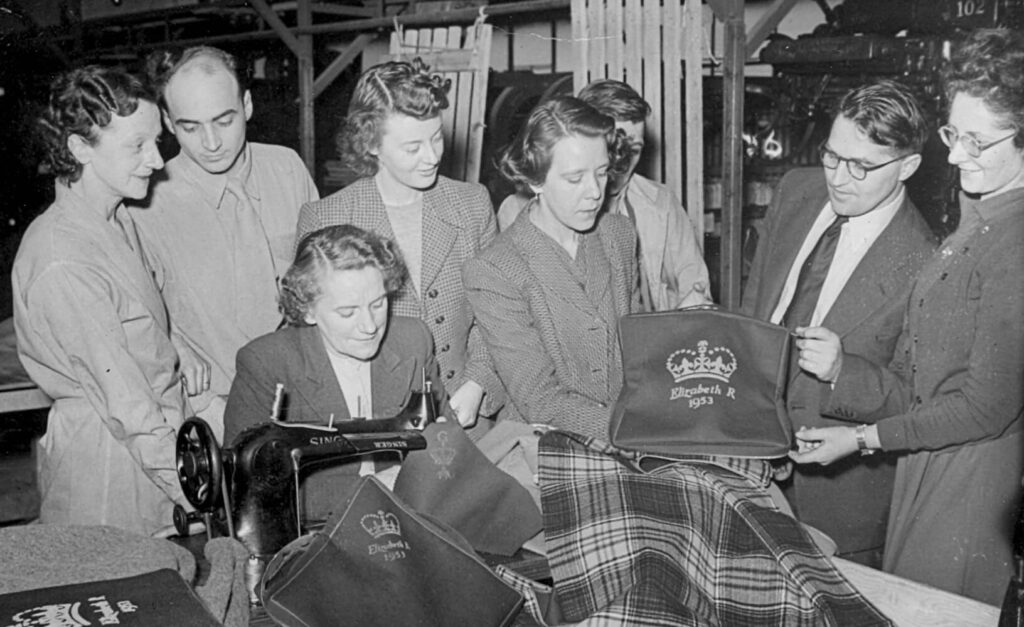
Joseph and Margaret Kagan, survivors of the Holocaust in Lithuania, came to the UK in 1946. They established Kagan Textiles Ltd. and opened a small factory in Elland. The business quickly grew after Joseph invented Gannex, and the company moved to a larger mill on Dewsbury Road, (featured in the new online UK Holocaust Map). Gannex raincoats were worn by Prime Minister Harold Wilson as well as the Queen and the Duke of Edinburgh. The company had over 1,000 employees.
Elena Lederman, born in Milan in 1917. Survived the Holocaust in hiding in Belgium. Came to the UK in 1955 and established Elena Chocolates. Elena was invited to bring a box of chocolates for The Queen to Buckingham Palace, after which the Queen would go to Harrods to buy more white chocolate. Elena also supplied chocolate to the Queen Mother on a monthly basis, and also to Princess Diana.
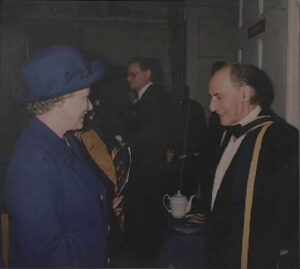
Composer Joseph Horovitz was presented to The Queen after the performance of his composition to celebrate her visit to the Royal College of Music in the year of her Golden Jubilee, 1997.
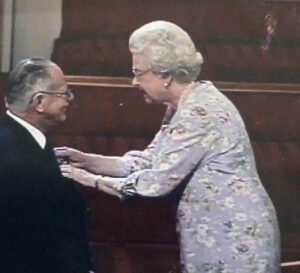
Rabbi Harry Jacobi received his MBE from The Queen at Buckingham Palace in 2006.
Here is an extract from interviewee Elise Duhl’s Refugee Voices testimony:
Interviewer: How would you describe yourself, first of all, in terms of nationality, how would you describe yourself?
ED: English. British. I love being British, I love my passport, I love everything.
Interviewer: When did you become British?
ED: Well, my… I got naturalised when I was eighteen. That was the age when you could become naturalised. My parents became naturalised, but you couldn’t until you reached the age of eighteen, so I was naturalised with them. I got my passport and everything.
Interviewer: Do you feel different to the British in any way?
ED: No, no, I feel British. I am always grateful for them accepting us here, I am. If I saw the Queen, to speak to her, I would thank her, really. I often thought of writing a letter because, you know, I watched her grow up. And I feel very English and very accepted here, I don’t feel out of place at all.
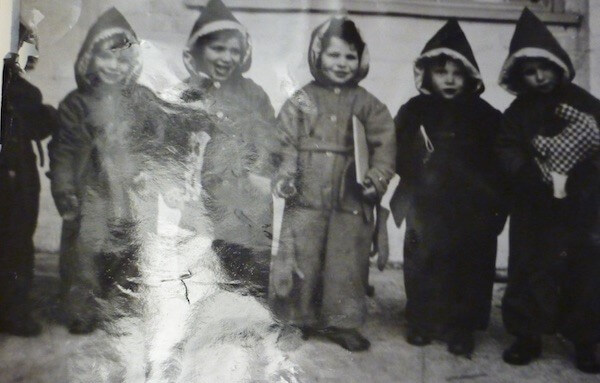 And, perhaps best of all, child concentration camp survivor Jackie Young, aged three, with other child survivors, dressed to meet the Royal Family including The Queen on a cold day at Bulldogs Bank in Sussex where they were being rehabilitated in 1945.