
People, Cars and people’s cars
Cars
,Germany
,Ideology
,Nazis
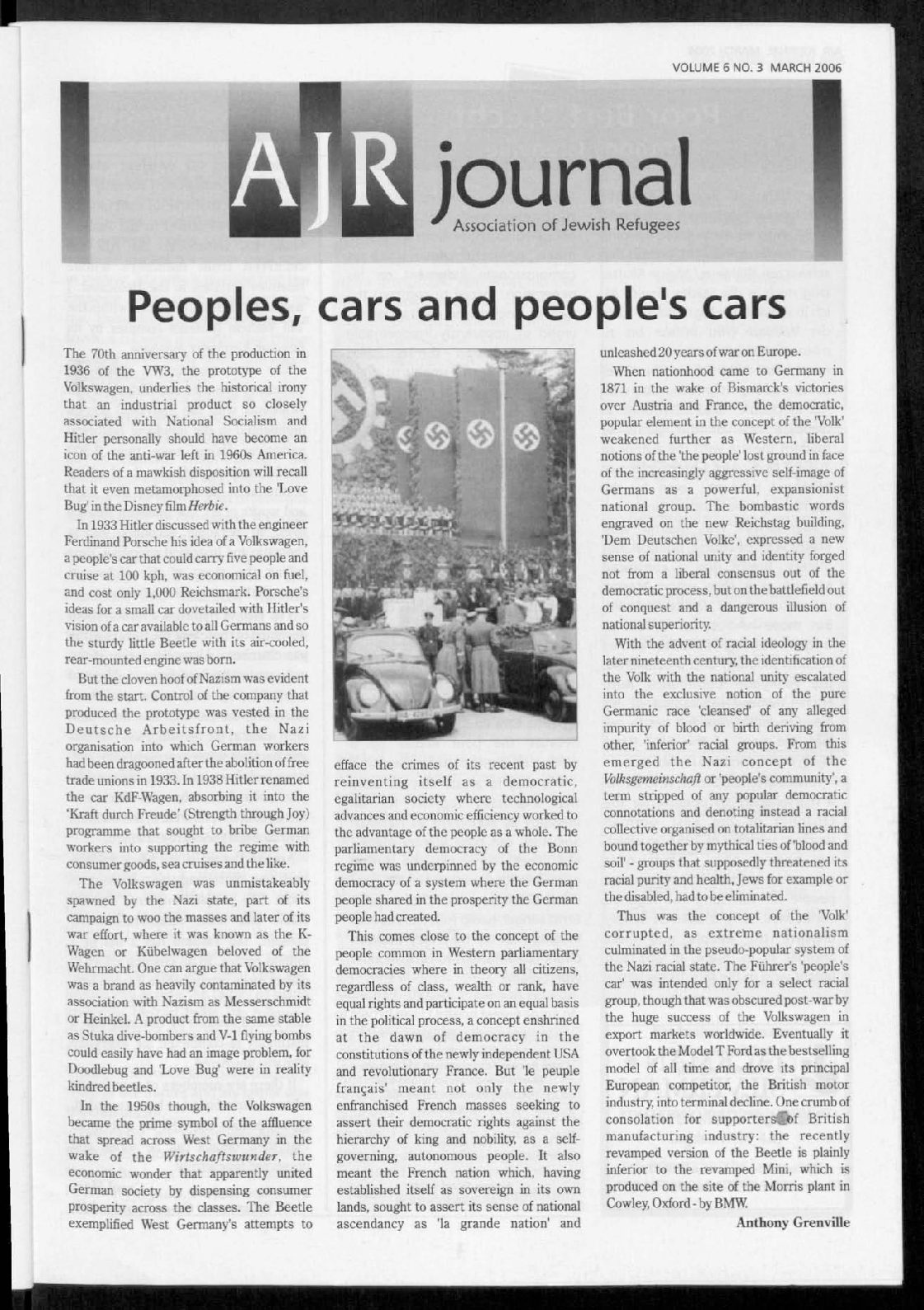
The 70th anniversary of the production in 1936 of the VW3, the prototype of the Volkswagen, underlies the historical irony that an industrial product so closely associated with National Socialism and Hitler personally should have become an icon of the anti-war left in 1960s America. Readers of a mawkish disposition will recall that it even metamorphosed into the ‘Love Bug’ in the Disney film Herbie. In 1933 Hitler discussed with the engineer Ferdinand Porsche his idea of a Volkswagen, a people’s car that could carry five people and cruise at 100 kph, was economical on fuel, and cost only 1,000 Reichsmark. Porsche’s ideas for a small car dovetailed with Hitler’s vision of a car available to all Germans and so the sturdy little Beetle with its air-cooled, rear-mounted engine was born. But the cloven hoof of Nazism was evident from the start. Control of the company that produced the prototype was vested in the Deutsche Arbeitsfront, the Nazi organisation into which German workers had been dragooned after the abolition of free trade unions in 1933. In 1938 Hitler renamed the car KdF-Wagen, absorbing it into the ‘Kraft durch Freude’ (Strength through Joy) programme that sought to bribe German workers into supporting the regime with consumer goods, sea cruises and the like. The Volkswagen was unmistakably spawned by the Nazi state, part of its campaign to woo the masses and later of its war effort, where it was known as the KWagen or Kiibelwagen beloved of the Wehrmacht. One can argue that Volkswagen was a brand as heavily contaminated by its association with Nazism as Messerschmidt or Heinkel. A product from the same stable as Stuka dive-bombers and V-1 flying bombs could easily have had an image problem, for Doodlebug and ‘Love Bug’ were in reality kindred beetles. In the 1950s though, the Volkswagen became the prime symbol of the affluence that spread across West Germany in the wake of the Wirtschaftsuiunder, the economic wonder that apparently united Gennan society by dispensing consumer prosperity across the classes. The Beetle exemplified West Germany’s attempts to efface the crimes of its recent past by reinventing itself as a democratic, egalitarian society where technological advances and economic efficiency worked to the advantage of the people as a whole. The parliamentary democracy of the Bonn regime was underpinned by the economic democracy of a system where the German people shared in the prosperity the German people had created. This comes close to the concept of the people common in Western parliamentary democracies where in theory all citizens, regardless of class, wealth or rank, have equal rights and participate on an equal basis in the political process, a concept enshrined at the dawn of democracy in the constitutions of the newly independent USA and revolutionary France. But ‘le peuple francais’ meant not only the newly enfranchised French masses seeking to assert their democratic rights against the hierarchy of king and nobility, as a self-governing, autonomous people. It also meant the French nation which, having established itself as sovereign in its own lands, sought to assert its sense of national ascendancy as ‘la grande nation’ and unleashed 20 years of war on Europe. With the advent of racial ideology in the later nineteenth century, the identification of the Volk with the national unity escalated into the exclusive notion of the pure Germanic race ‘cleansed’ of any alleged impurity of blood or birth deriving from other, ‘inferior’ racial groups. From this emerged the Nazi concept of the Volksgemeinschaft or ‘people’s community’, a term stripped of any popular democratic connotations and denoting instead a racial collective organised on totalitarian lines and bound together by mythical ties of ‘blood and soil’ – groups that supposedly threatened its racial purity and health, Jews for example or the disabled, had to be eliminated. Thus was the concept of the ‘Volk’ corrupted, as extreme nationalism culminated in the pseudo-popular system of the Nazi racial state. The Fuhrer’s ‘people’s car’ was intended only for a select racial group, though that was obscured post-war by the huge success of the Volkswagen in export markets worldwide. Eventually it overtook the Model T Ford as the best-selling model of all time and drove its principal European competitor, the British motor industry, into terminal decline. One crumb of consolation for supporters of British manufacturing industry: the recently revamped version of the Beetle is plainly inferior to the revamped Mini, which is produced on the site of the Morris plant in Cowley, Oxford – by BMW.