
Internment in Australia
Australia
,Deported
,Dunera
,Wrongly Prosecuted
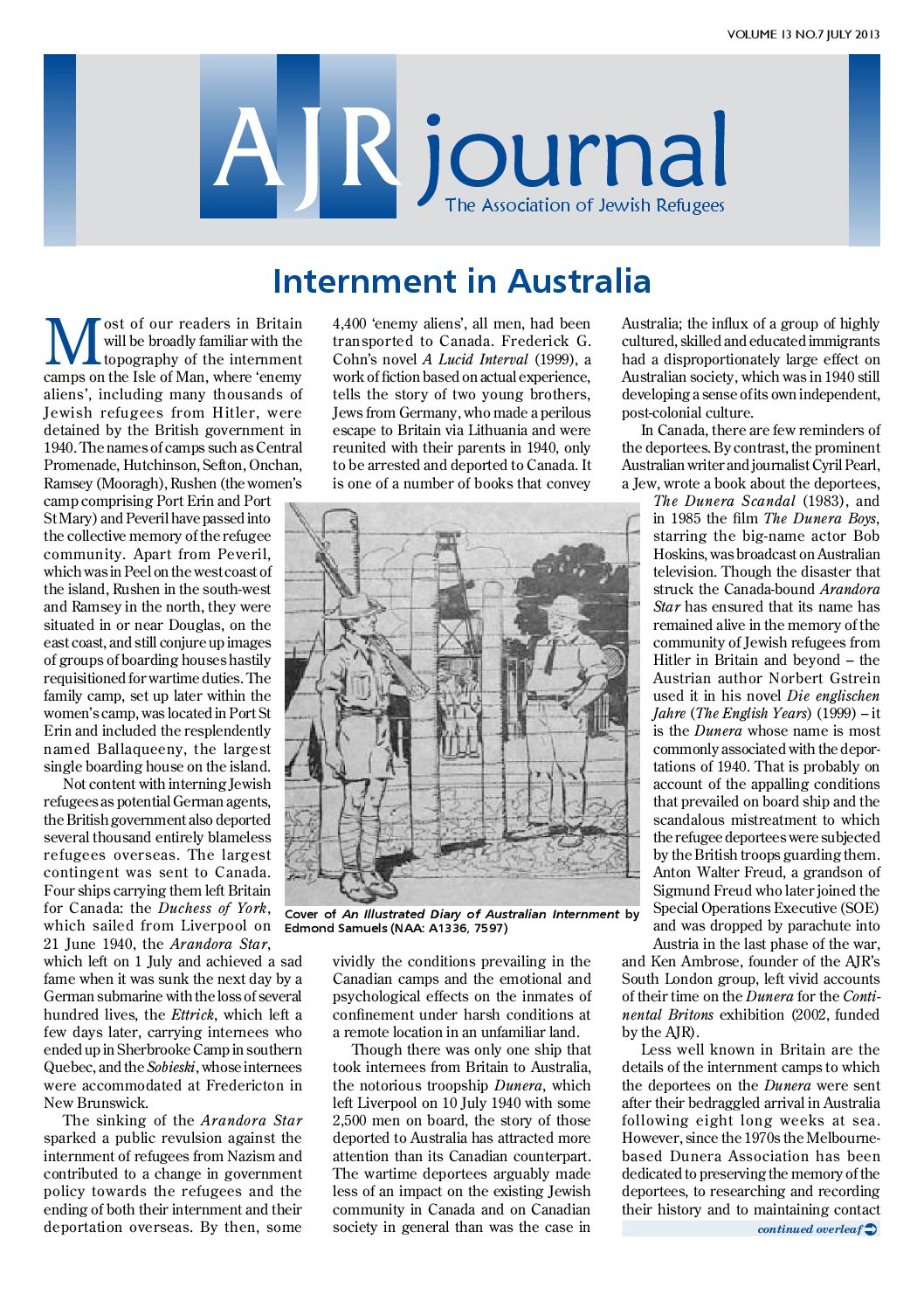
Most of our readers in Britain will be broadly familiar with the topography of the internment camps on the Isle of Man, where ‘enemy aliens’, including many thousands of Jewish refugees from Hitler, were detained by the British government in 1940. The names of camps such as Central Promenade, Hutchinson, Sefton, Onchan, Ramsey (Mooragh), Rushen (the women’s camp comprising Port Erin and Port St Mary) and Peveril have passed into the collective memory of the refugee community. Apart from Peveril, which was in Peel on the west coast of the island, Rushen in the south-west and Ramsey in the north, they were situated in or near Douglas, on the east coast, and still conjure up images of groups of boarding houses hastily requisitioned for wartime duties. The family camp, set up later within the women’s camp, was located in Port St Erin and included the resplendently named Ballaqueeny, the largest single boarding house on the island. Not content with interning Jewish refugees as potential German agents, the British government also deported several thousand entirely blameless refugees overseas. The largest contingent was sent to Canada. Four ships carrying them left Britain for Canada: the Duchess of York, which sailed from Liverpool on 21 June 1940, the Arandora Star, which left on 1 July and achieved a sad fame when it was sunk the next day by a German submarine with the loss of several hundred lives, the Ettrick, which left a few days later, carrying internees who ended up in Sherbrooke Camp in southern Quebec, and the Sobieski, whose internees were accommodated at Fredericton in New Brunswick. The sinking of the Arandora Star sparked a public revulsion against the internment of refugees from Nazism and contributed to a change in government policy towards the refugees and the ending of both their internment and their deportation overseas. By then, some 4,400 ‘enemy aliens’, all men, had been transported to Canada. Frederick G. Cohn’s novel A Lucid Interval (1999), a work of fiction based on actual experience, tells the story of two young brothers, Jews from Germany, who made a perilous escape to Britain via Lithuania and were reunited with their parents in 1940, only to be arrested and deported to Canada. It is one of a number of books that convey vividly the conditions prevailing in the Canadian camps and the emotional and psychological effects on the inmates of confinement under harsh conditions at a remote location in an unfamiliar land. Though there was only one ship that took internees from Britain to Australia, the notorious troopship Dunera, which left Liverpool on 10 July 1940 with some 2,500 men on board, the story of those deported to Australia has attracted more attention than its Canadian counterpart. The wartime deportees arguably made less of an impact on the existing Jewish community in Canada and on Canadian society in general than was the case in Australia; the influx of a group of highly cultured, skilled and educated immigrants had a disproportionately large effect on Australian society, which was in 1940 still developing a sense of its own independent, post-colonial culture. In Canada, there are few reminders of the deportees. By contrast, the prominent Australian writer and journalist Cyril Pearl, a Jew, wrote a book about the deportees, The Dunera Scandal (1983), and in 1985 the film The Dunera Boys, starring the big-name actor Bob Hoskins, was broadcast on Australian television. Though the disaster that struck the Canada-bound Arandora Star has ensured that its name has remained alive in the memory of the community of Jewish refugees from Hitler in Britain and beyond – the Austrian author Norbert Gstrein used it in his novel Die englischen Jahre (The English Years) (1999) – it is the Dunera whose name is most commonly associated with the deportations of 1940. That is probably on account of the appalling conditions that prevailed on board ship and the scandalous mistreatment to which the refugee deportees were subjected by the British troops guarding them. Anton Walter Freud, a grandson of Sigmund Freud who later joined the Special Operations Executive (SOE) and was dropped by parachute into Austria in the last phase of the war, and Ken Ambrose, founder of the AJR’s South London group, left vivid accounts of their time on the Dunera for the Continental Britons exhibition (2002, funded by the AJR). Less well known in Britain are the details of the internment camps to which the deportees on the Dunera were sent after their bedraggled arrival in Australia following eight long weeks at sea. However, since the 1970s the Melbournebased Dunera Association has been dedicated to preserving the memory of the deportees, to researching and recording their history and to maintaining contact between the surviving former deportees as well as their descendants. Since 1984 the Association has published the Dunera News, which in March 2013 reached its 87th number and which contains a great deal of information about the two principal camps to which the deportees were sent. I am indebted for much of the following detail to this publication and to the Austrian scholar Professor Elisabeth Lebensaft, who recently visited Australia to research the Austrians among the ‘Dunera Boys’; the resulting paper, written with Christine Kanzler, is entitled ‘“It’s a Story You Will Never Forget”: Auf den Spuren österreichischer Dunera Boys in Australien’ (On the Trail of Austrian Dunera Boys in Australia). The Dunera reached Sydney on 6 September 1940. From there, most of the deportees were taken by train to Hay, in the Riverina district of New South Wales, deep in the remote Australian outback, where they were housed in two camps (the third held Italian internees). Conditions in the isolated, semi-desert location were primitive and debilitating and the detainees suffered from heat, insect parasites and the sand that was continually blown into the huts accommodating them. The artist Johannes Matthäus Koelz, a political refugee from Hitler, recorded their arrival at Hay station: A cloud of dust appeared on the horizon, approaching at some speed. As it came nearer, it turned out to be a cloud of flies enveloping half a dozen skinny horses and their riders – our escort to camp. We took up whatever luggage was left to us, and trudging over sandy soil in a landscape much flatter than a pancake could ever be we quickly reached a double line of huge posts of fantastic shape and enormous thickness, connected by rows of barbed wire. A door opened, in we went, and the door closed again. We had arrived. No huts, no tents … A square mile of sand, surrounded by these knobbly, surrealistically unreal silhouettes of massive eucalyptus trunks. (Quoted from the biography of Koelz, Three Point Perspective, by his daughter Ava M. Farrington) Despite the conditions, under which the only occupation seemed to be swimming in the turgid waters of the Murrumbidgee River, the detainees contrived to create a rich cultural and intellectual life, remark