
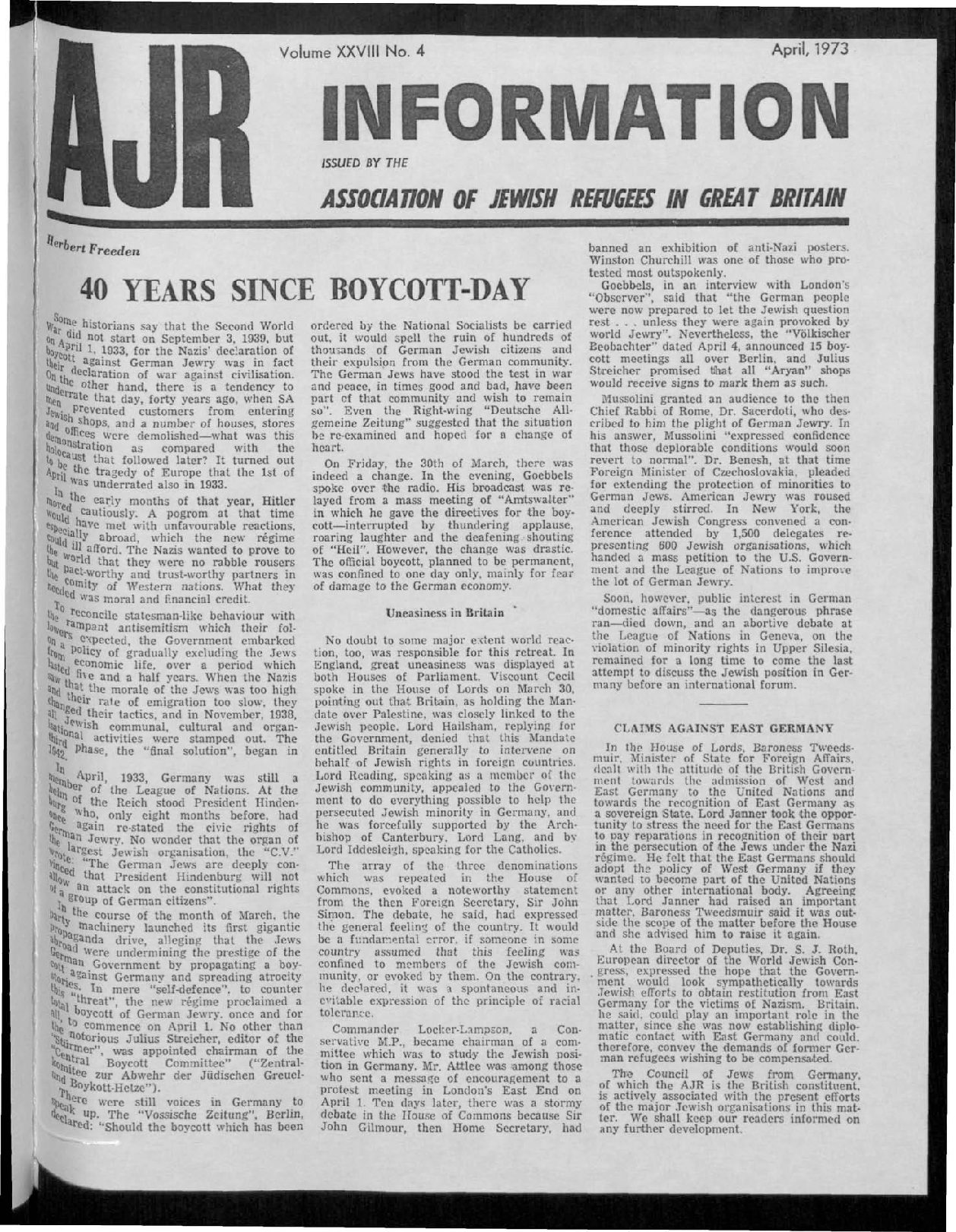
40 years since boycott day
Berlin
,Reconciliation
Some historians say that the Second World War did not start on September 3, 1939, but 1. 1933, for the Nazis’ declaration of Boycott against German Jewry was in fact of course their de claration of war against civilisation. On the other hand, there is a tendency to underate that day, forty years ago, when SA men prevented customers from entering Jewish shops, and a number of houses, stores and offices were demolished—what was this demonstration compared with the 1st of April that followed later? It turned out April tragedy of Europe that the 1st of April was underrated also in 1933. In the early months of that year Hitler at that time have met with unfavourable reactions, specially abroad, which the new regime could ill aford. The Nazis wanted to prove to the world that they were no rabble rousers but pact-worthy and trust-worthy partners in the comity of Western nations. What they needed was moral and financial credit. To conciliate statesman-like behaviour with the rampant antisemitism which their followers expected , the Government embarked on a policy of gradually excluding the Jews from economic life, over a period which lasted five and a half years. When the Nazis saw that the morale of the Jews was too high and their rate of emigration too slow, they changed their tactics, and in November, 1938, all Jewish communal, cultural and organizational activities were stamped out. The third phase the “final solution”, began in 1942. In April, 1933, Germany was still a member of the League of Nations. At the Helm of the Reich stood President Hindenburg, only eight months before, had once again re-stated the civic rights of German Jewry. No wonder that the organ of the largest Jewish organisation, the “C.V.” wrote: “The German Jews are deeply convinced that President Hindenburg will not allow attack on the constitutional rights of a group of German citizens”. In the course of the month of March, the party machinery launched its first gigantic propaganda drive, alleging that the Jews abroad are undermining the prestige of the German” Government by propagating a boycott against Germany and spreading atrocity stories. In mere “self-defence”, to counter this threat”, the new regime proclaimed a total boycott of German Jewry, once and for the commence on April 1. No other than the notorious Julius Streicher, editor of the ”Stuermer”, was appointed chairman of the “Central Boycott Committee” (“Zentralkomitee zur Abwehr der Juedischen Greul- und Boykott-Hetze”). There were still voices in Germany to speak up. The “Vossische Zeitung”, Berlin, declared: “Should the boycott which has been ordered by the National Socialists be carried out, it would spell the ruin of hundreds of thousands of German Jewish citizens and their expulsion from the German community. The German Jews have stood the test in war and peace, in times good and bad, have been part of that community and wish to remain so”. Even the Right-wing “Deutsche Allgemeine Zeitung” suggested that the situation lye re-examined and hoped for a change of heart. On Friday, the 30th of March, there was indeed a change. In the evening, Goebbels spoke over the radio. His broadcast was relayed from a mass meeting of “Amtswalter” in which he gave the directives for the boycott—interrupted by thundering applause roaring laughter and the deafening shouting of “Heil”. However, the change was drastic. The official boycott, planned to be permanent, was confined to one day only, mainly for fear of damage to the German economy. Uneasiness in Britain No doubt to some major extent world reaction, too, was responsible for this retreat. In England, great uneasiness was displayed at both Houses of Parliament. Viscount Cecil spoke in the House of Lords on March 30. pointing out that Britain, as holding the Mandate over Palestine, was closely linked to the Jewish people. Lord Hailsham. replying for the Government, denied that this Mandate entitled Britain generally to intervene on behalf of Jewish rights in foreign countries. Lord Reading, speaking as a member of the Jewish community, appealed to the Government to do everything possible to help the persecuted Jewish minority in Germany, and he was forcefully supported by the Archbishop of Canterbury, Lord Lang, and by Lord Iddesleigh, speaking for the Catholics. The array of the three denominations which was repeated in the House of Commons, evoked a noteworthy statement from the then Foreign Secretary, Sir John Simon. The debate, he said, had expressed the general feeling of the country. It would be a fundamental error, if someone in some country assumed that this feeling was confined to members of the Jewish community, or evoked by them. On the contrary, he declared, it was a spontaneous and inevitable expression of the principle of racial tolerance. Commander Locker-Lampson. a Conservative M.P., became chairman of a committee which was to study the Jewish position in Germany. Mr. Attlee was among those who sent a message of encouragement to a protest meeting in London’s East End on April 1. Ten days later, there was a stormy debate in the House of Commons because Sir John Gilmour, then Home Secretary, had banned an exhibition of anti-Nazi posters. Winston Churchill was one of those who protested most outspokenly. Goebbels, in an interview with London’s “Observer’, said that “the German people were now prepared to let the Jewish question rest . . , unless they were again provoked by world Jewry”. Nevertheless, the “Voelkischer Beobachter” dated April 4, announced 15 boycott meetings all over Berlin, and Julius Streicher promised that all “Aryan” shops would receive signs to mark them as such. Mussolini granted an audience to the then Chief Rabbi of Rome, Dr. Saccrdoti, who described to him the plight of German Jewry. In his answer, Mussolini “expressed confidence that those deplorable conditions would soon revert to normal”. Dr. Benesh, at that time Foreign Minister of Czechoslovakia, pleaded for extending the protection of minorities to German Jews. American Jewry was roused and deeply stirred. In New York, the -American Jewish Congress convened a conference attended by 1,500 delegates representing 600 Jewish organisations, which handed a mass petition to the U.S. Government and the League of Nations to improve the lot of German Jewry. Soon, however, public interest in German “domestic affairs”—as the dangerous phrase ran—died down, and an abortive debate at the League of Nations in Geneva, on the violation of minority rights in Upper Silesia, remained for a long time to come the last attempt to discuss the Jewish position in Germany before an international forum.