
Days of rememberance
ww2
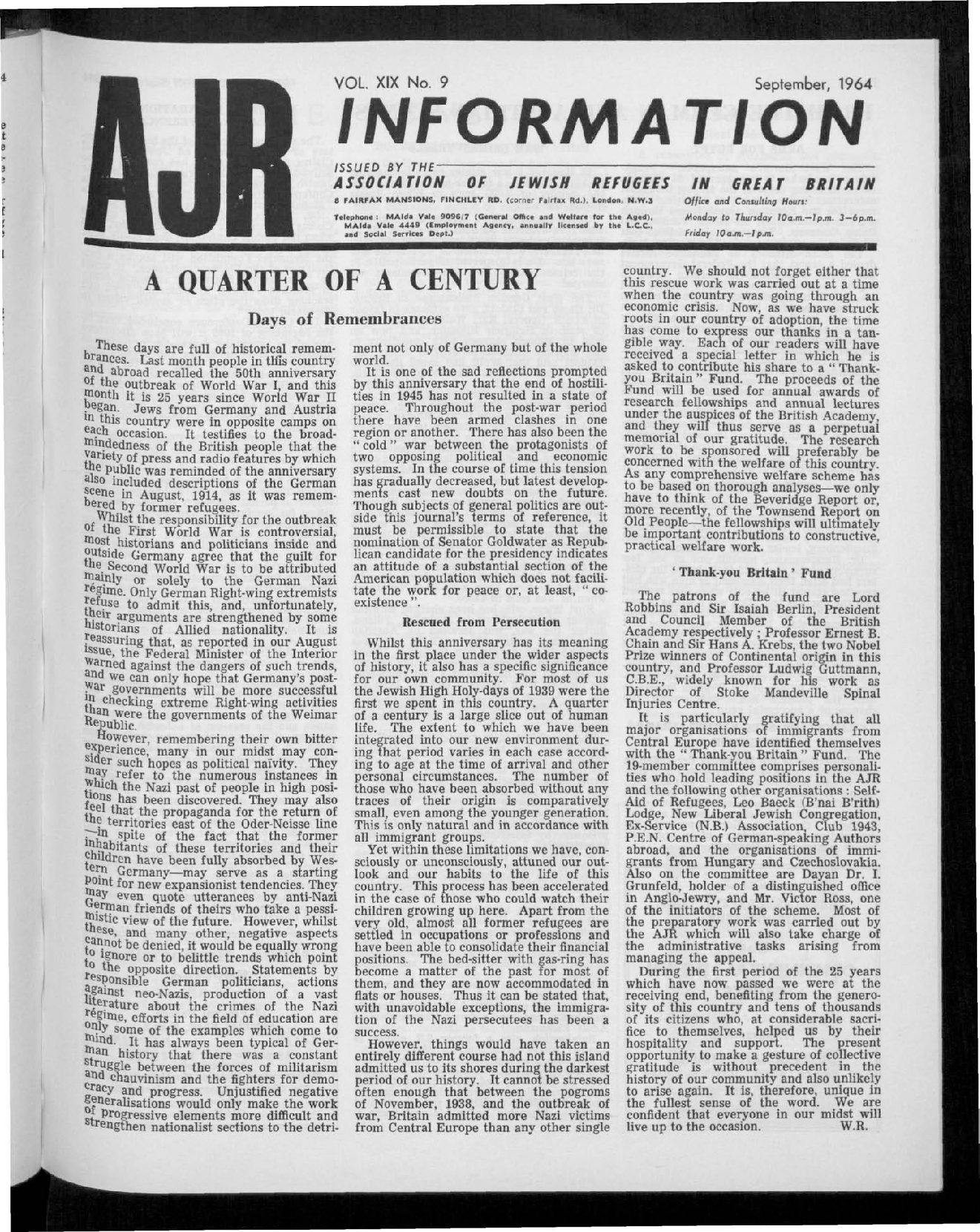
Days of Remembrances These days are full of historical remembrance. Last month people in this country and abroad recalled the 50th anniversary of the outbreak of World War I, and this Month it is 25 years since World War II began. Jews from Germany and Austria in this country were in opposite camps on each occasion. It testifies to the broad mindedness of the British people that the variety of press and radio features by which the public was reminded of the anniversary also included descriptions of the German scene in August, 1914, as it was remembered former refugees, Whilst the responsibility for the outbreak of the First World War is controversial, most historians and politicians inside and outside Germany agree that the guilt for “the Second World War is to be attributed “mainly or solely to the German Nazi Regime. Only German Right-wing extremists refuse to admit this, and, unfortunately, in their arguments are strengthened by some historians of Allied nationality. It is reassuring that, as reported in our August issue, the Federal Minister of the Interior warned against the dangers of such trends, and we can only hope that Germany’s postwar governments will be more successful in checking extreme Right-wing activities than were the governments of the Weimar However, remembering their own bitter experience, many in our midst may consider such hopes as political naivety. They may refer to the numerous instances in which the Nazi past of people in high positions has been discovered. They may also feel that the propaganda for the return of the territories east of the Oder-Neisse line inspite of the fact that the former inhabitants of these territories and their children have been fully absorbed by Western Germany—may serve as a starting point for new expansionist tendencies. They may even quote utterances by anti-Nazi German friends of theirs who take a pessimistic view of the future. However, whilst these, and many other, negative aspects cannot be denied, it would be equally wrong to Ignore or to belittle trends which point out the opposite direction. Statements by responsible German politicians, actions .against neo-Nazis, production of a vast nerature about the crimes of the Nazi regime, efforts in the field of education are only some of the examples which come to mind- It has always been typical of German history that there was a constant giggle between the forces of militarism and chauvinism and the fighters for democrazy and progress. Unjustified negative serializations would only make the work progressive elements more difficult and strengthen nationalist sections to the detriment not only of Germany but of the whole world. It is one of the sad reflections prompted by this anniversary that the end of hostilities in 1945 has not resulted in a state of peace. Throughout the post-war period there have been armed clashes in one region or another. There has also been the ” cold ” war between the protagonists of two opposing political and economic systems. In the course of time this tension has gradually decreased, but latest developments cast new doubts on the future. Though subjects of general politics are outside this journal’s terms of reference, it must be permissible to state that the nomination of Senator Goldwater as Republican candidate for the presidency indicates an attitude of a substantial section of the American population which does not facilitate the work for peace or, at least, ” coexistence “. Rescued from Persecution Whilst this anniversary has its meaning in the first place under the wider aspects of history, it also has a specific significance for our own community. For most of us the Jewish High Holy-days of 1939 were the first we spent in this country. A quarter of a century is a large slice out of human life. The extent to which we have been integrated into our new environment during that period varies in each case according to age at the time of arrival and other personal circumstances. The number of those who have been absorbed without any traces of their origin is comparatively small, even among the younger generation. This is only natural and in accordance with all immigrant groups. Yet within these limitations we have, consciously or unconsciously, attuned our outlook and our habits to the life of this country. This process has been accelerated in the case of those who could watch their children growing up here. Apart from the very old, almost all former refugees are settled in occupations or professions and have been able to consolidate their financial positions. The bed-sitter with gas-ring has become a matter of the past for most of them, and they are now accommodated in fiats or houses. Thus it can be stated that, with unavoidable exceptions, the immigration of the Nazi persecutees has been a success. However, things would have taken an entirely different course had not this island admitted us to its shores during the darkest period of our history. It cannot be stressed often enough that between the pogroms of November, 1938, and the outbreak of war, Britain admitted more Nazi victims from Central Europe than any other single country. We should not forget either that this rescue work was carried out at a time when the country was going through an economic crisis. Now, as we have struck roots in our country of adoption, the time has come to express our thanks in a tangible way. Each of our readers will have received a special letter in which he is asked to contribute his share to a ” Thank you Britain ” Fund. The proceeds of the Fund will be used for annual awards of research fellowships and annual lectures under the auspices of the British Academy, and they will thus serve as a perpetual memorial of our gratitude. The research work to be sponsored will preferably be concerned with the welfare of this country. As any comprehensive welfare scheme has to be based on thorough analyses—we only have to think of the Beveridge Report or, more recently, of the Townsend Report on Old People—the fellowships will ultimately be important contributions to constructive, practical welfare work.