
Eva Mendelsson
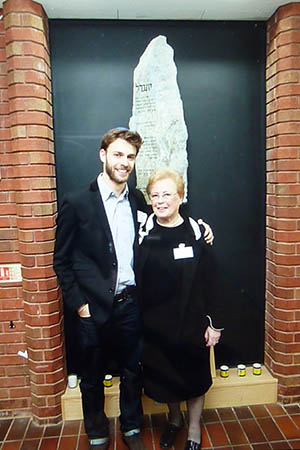
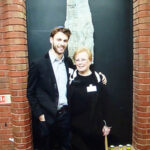
EM: With her grandson outside Pinner Synagogue for her Yom Hashoah talk
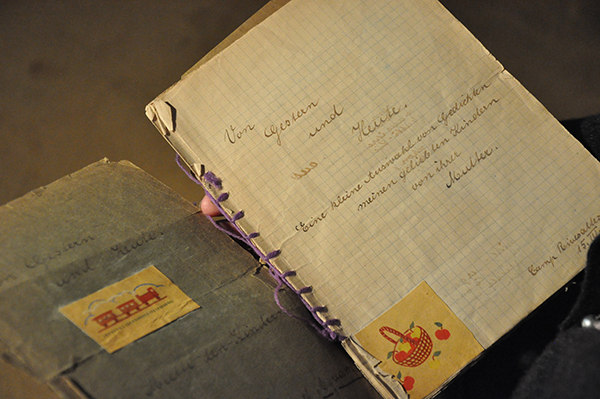
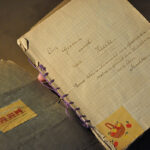
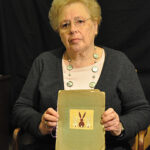
EM: Book of poems made by her mother in Rivesaltes camp for Eva's 11th birthday
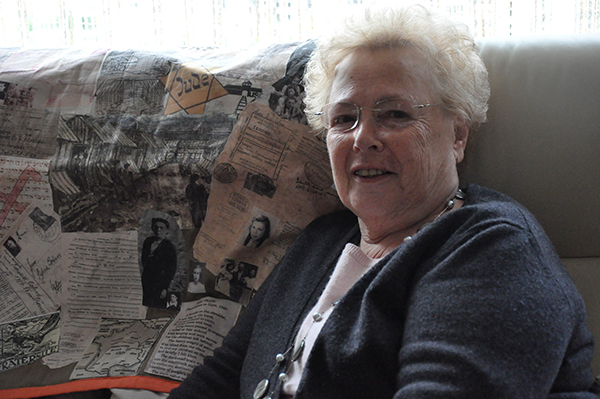
EM: Textile montage
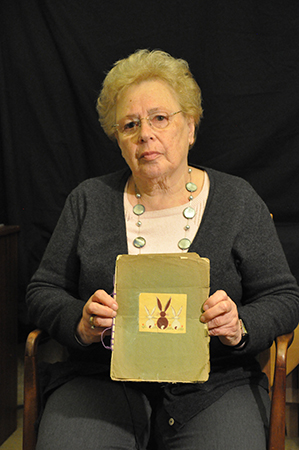
EM: Book of poems made by her mother in Rivesaltes camp for Eva's 11th birthday
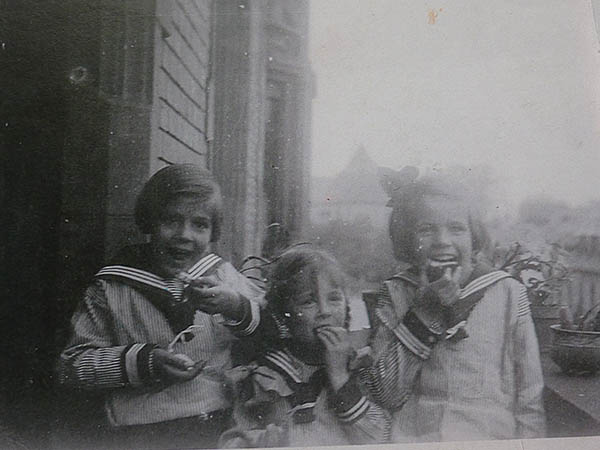
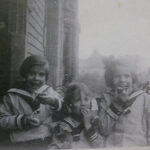
EM: With her sisters on the veranda in Augustenstrasse
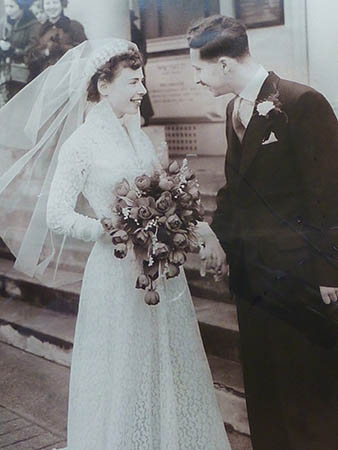
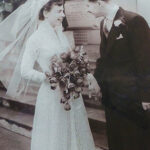
EM: Wedding day to Walter
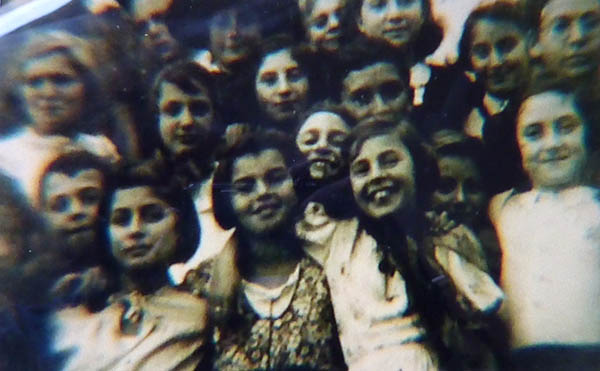
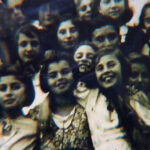
EM: In the middle with the white scarf at Masgelier
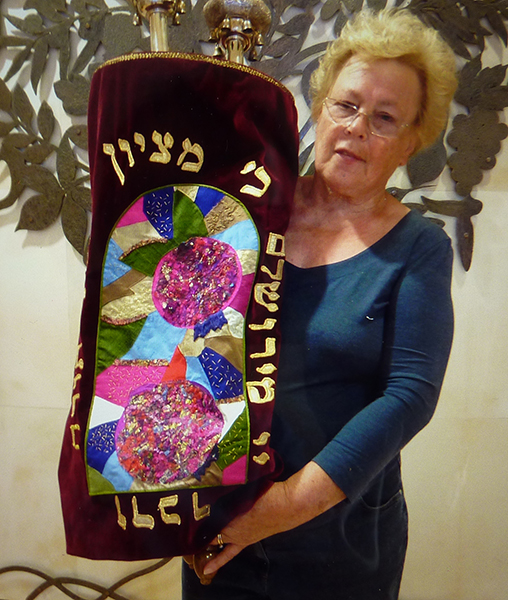
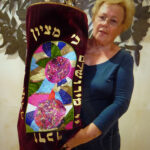
EM: Scroll with pomegranates to commemorate her mother and sister
Eva Mendelsson
Born: 1931
Place of Birth: Gengenbach
Arrived in Britain: 01/10/1945
Interview Number: RV174
Interview Summary
Date of interview: 18/05/2016
Eva Mendelsson, nee Eva Judith Cohn, was born in 1931 in Gengenbach and grew up in Offenburg, where she was the only Jewish child in her class. Toghether with her two sisters they were sent to a Jewish school in Freiburg, where each of the sisters had to board with a Jewish family. Eva recalls Eva’s father was arrested on Kristallnacht and imprisoned for six week. When he came back Eva did not recognize him. A condition of his release was that he needed to emigrate. He managed to get a transit visa to the UK where he was sent to the Kitchener Camp.
When war broke out Eva’s mother took her and her two sisters to Munich. They stayed there for a while and then went back to Offenburg. One of Eva’s sisters stayed behind in Munich in a children’s home, as the mother thought that it would be easier for her in Munich, as she could not walk properly due to having contracted polio as a small child. The mother gave her sister a diary and hoped that might help her to be apart from the family. When they came back, Eva continued to board in Freiburg.
On 21 and 22 October 1940 about 6500 Jews from Baden and Saarpfalz were deported to France. Eva was not allowed to go back to her mother and went to the deportation with the family from Freiburg. On the train, she met her mother and sister, who found themselves in the same transport. In France they were taken to an internment camp in Gurs. In March 1941, Eva, her sister and mother were taken to another internment camp in Rivesaltes (near Perpignan). Through the help of the Œuvre de Secours aux Enfants (OSE), the children were taken out of the camps and housed in children home. Eva and her sister went to a children’s home in Château du Masgeliers (1941-1942) and then to a convent in La Souterraine, Creuse. At some point they were brought back to Camp Rivesaltes. Eva recalls that her mother had a laissez passez to go to the beach with Eva and her sister. On that trip they also visited her aunt who was in Perpignan.
In August 1942 an order was given to deport Eva, her mother, and her sister and all other Jews (first to Drancy and later to Auschwitz). OSE convinced Eva’s mother to leave the children behind. Before the children parted with their mother, she gave them a book of her poetry (which Eva cherishes and she reads some poems at the end of the interview). The children were taken to a convent and in 1943 smuggled to Switzerland (through Annemasse). First they were interned in Geneva and later taken to a children home in Ascona (Tessin). In October 1945 Eva and her sister came to the UK to join their father. They found out that her sister died in 1944 in Theresienstadt and that her mother died in 1942 (they were sent a certifictae which says that the mother died due to heart failure).
The situation with the father was not easy as they had not seen him for seven years. He remarried and Eva studied hotel managment and worked in many jobs. She met her husband in the Habonim youth movement, got married in 1954, and had three children. She is and active member of Alyth Synagogue and started working as a textile artist. Eva speaks regularly in Germany and co-edited several volumes of her mother’s poetry and her sister’s diary . She has not been speaking much in the UK.
Place of Birth
It was a camp originally made for the 1937 Spanish Civil War. There were still a few Spaniards there. I didn’t know why, but they were still there. They knew the ropes of the camp more, and we were totally shocked. We were given- We were told, “Here is a- Here is a – a paliasse;” - a sack - “fill it with straw, and that will be your bed.” So you come from quite civilized place, and now you have this space in a barrack which is the width of your mattress. That is the space that you occupy. During the day, you pushed it back, and it was your seat, and during the night you pushed it back and it was your bed. We had a blanket and this sack. We were treated... terribly. We had to go for miles to go to the latrines to the toilets because... to avoid sickness. We all, but we had rats, we had mice, we had - you name it. Old people died. They were taken out in the middle of the night. You had people fighting because fifty people in a barrack, they were hungry they were miserable, and it doesn’t take much to have... rows. We didn’t know what was worse, the scratching from our... bites, or the hunger from our stomach. It was- The situation was just appalling. We didn’t have any schooling whatsoever. The water was on for about an hour in the morning and an hour in the evening, and that was miles away. If you imagine it like maybe in the Army they have such things. There were lots and lots of taps and you washed in the open.
Life in Gurs
Be strong my heart and patient, even if your longing is unsatisfied, we are half way up the ladder, we have to continue the laborious climbing and nothing is fulfilled. Be strong my heart and patient, the light of hope may be the driving force. You’ll have to wait much longer and bear fate’s many hard blows. Let’s not despair! Be strong my heart, and patient. You’ll have to get through to reach the goal. A rose coloured light in the sky is warning that suffering will come to an end.
Translated poem by Eva Mendelsson's mother in Rivesaltes
There was a decree that the German children from homes – I was in a children’s home [having left her mother in Rivesaltes by then] - had to go back to the camp... right? And then we were, the reason why we were supposed to be on the list to be deported with my mother. But people have implored my mother to leave us behind. And she... relented, and said she’d go by herself because she knew her fate was the east - and that was death. So I mean she gave us life twice.
Not returning to Rivesaltes to be deported
15 of us went by night, we were assembled. You only had what you were wearing. So therefore you wore 2 pants, 2 socks. We were told to be utterly quiet, to do exactly what we were told. If anybody shouts 'Appla!’ we go flat on our stomachs & not to cry, not to do anything of that nature. We were good. We had a passeur, he’s the man who shows you the way. This 15 of us went across & had to climb what seemed a very high barbed wire. Could be a 12 year old child it’s different from what it was in reality. We were told when we get to the other side they will shout, “Halte là!”, and you stop dead in your tracks, or they shoot. So we climbed up & we go to the other side & exactly that happened. “Halte là!”, & we stopped. Then they took us by lorry to a suburb of Geneva & we were interrogated. It went like this: ‘Un jour je passait en Suisselle, Il a gendarme m’ont arêtes J’avais la bouges jus’qua… Et les pantalons dechirees On m’ammenait aux bureau Comme tout le monde... Ma fouille.... Comme tout le monde. ....... Je ne coucherais quelle mais elle se couchait cinq minutes apres elle comme tout le monde. Quelle Et les interrogatoirent, par un monsieur et par ecrit C’etait un vrai purgatoire, Et quand cela etait finis. La visite medicale comme tout le monde. Il fallait se mettre... Devant tout le monde. On cherchait le petit I can’t remember the rest. Anyway, that was the arrival in Switzerland. 3 weeks in quarantine, in a camp.'" INTERVIEWER: "Who wrote that song?" EVA: "Oh, don’t ask me. I- I can’t tell you. Lots of things I can’t tell you, I’m sorry. I, I, I don’t know. A lot of things that are just - they are there.
Escape to Switzerland
In the morning you got... coffee which is really black water. I don’t know what it was made of, it may be malt. I can’t tell you; it was just...hot water. And you had your – your, your little... tin, which was your cup... and a metal kind of a plate. We kids got, once a month, we got a plate full of special ration. A little bit of white fat. ...A piece of... sugar, which hadn’t been made sugar yet – in a piece... a spoonful of jam. And that was a special treat; once a month children got that. But otherwise you had a 150 grams of bread. Anyone who’d see the people when they’re cutting up that loaf. It was a round loaf. They but up, how they- had to make sure that each piece was exactly even. I had to learn... not to be greedy, wanting the biggest piece. It had to unlearn...You know, now in fact I think if I have a chip on my shoulder, it’s I always must make sure that if you dish out food for some reason or another, that you don’t have the most. That yours is the smallest. That it’s- It remains. It’s a kind of a- It remained with me.
Food in Rivesaltes
We were three days, three nights on this train. Put us on the sidings during the night and for how long it was, until we moved on again. And...after three days we arrived. My mother knew it wasn’t the east because she could see the Alps and the Pyrenees later on. So she knew it wasn’t the east. They were always frightened of the east.
Arriving in Gurs