
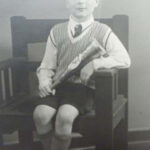
Frank Bright
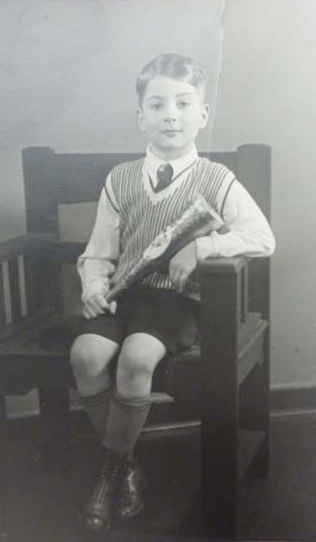
FB: First day at school (Jewish Reform Gemeindeschule in Joachimsthaler street)
Frank Bright
Born: 1928
Place of Birth: Berlin
Arrived in Britain: 01/06/1946
Interview Number: RV166
Interview Summary
Date of interview: 24/02/2016
Frank Bright/Brichta described himself as ‘vaguely Jewish’, indicating both his attitude towards religion, and his societal background. Nevertheless, he is strongly aware of being a survivor, and has endeavoured to trace those he knew in different circumstances, establishing their death or survival. He was born in 1928 in Berlin (Wilmersdorf), where his father joined Sigmund Pinkas and was ultimately the manager of a private Jewish bank. Whilst Hermann Brichta was originally from Vikos u Kyjova in Moravia, Czech Republic (formerly Czechoslovakia), his wife, Toni Brichta (nee Wasservogel), was a Berlin-born (Kreutzberg) steno-typist and linguist (German, English and French).
Although only four years old when the Nazis took power, Frank Bright could recall the mocking anti-Semitic cartoons on street corners, depicting Jews as either Bolsheviks or Capitalists, the signs banning Jews from entering e.g. cafes, and the low tones in which his mother and her friends spoke on a particular occasion. The ashes of a woman’s husband had been sent to her by post, for which she had had to pay. A Czechoslovak flag worn in Frank’s lapel acted as a talisman against these developments – temporarily at least. He was blond and ‘not Jewish-looking.’
In 1935, aged six, the interviewee joined a Jewish Reform School near the famous Ka de We store in Berlin, but for their own safety, Bright’s family had moved in June 1938 to Karlin, in Prague. ‘Prague was getting full of German and Austrian refugees’ and ‘Jews and Czechs knew what the Germans were capable of’, he observed. The September 1938 Munich crisis, however, whereby Czechoslovakia ceded the Sudetenland region to Germany, brought fresh dangers – ‘very depressing.’
As Czech schools were closed, Bright learnt Czech privately, and attended a Jewish school with German and Austrian refugee children – who ‘gradually disappeared’; most pupils were dead two weeks after a 1942 class photograph was taken. His father had time and some money, so wanted to help other people, while Toni stayed at home. Most of the six Jewish families in the block of flats perished. Frank ‘was the last link.’ He remembered clearly the terrifying knocks on the door during home-to-home Gestapo searches, following the May 1942 assassination of Deputy Reichsprotektor Reinhard Heydrich, and later the reprisals.
Most synagogues in the former Czechoslovakia still stood, Bright commented, but held ‘Nazi loot’; his Bar Mitzvah was therefore held in a prayer room. ‘The atmosphere in Czechoslovakia was one of fear, prohibition and rules’, with long lists of items that Jews had to surrender, resulting in deprivation and health problems. When Jewish schools were also closed in July/August 1943, Bright worked in a cemetery. For Jews/Aryans to mix was dangerous, and ‘Jewish youths felt depressed and demoralized – acutely miserable – their youth had gone’: some ‘joined the Zionist organization – only too conscious that no country wanted them.’
Denied access to newspapers or the radio, it was difficult to know what was happening; ‘we lived on rumours’ such as the 1943 Allied landings in Sicily [true]. Although the war continued for twenty-two more months, the news raised people’s hopes. Nonetheless, on 12 July 1943 Transport Di took Bright’s family to Terezin (Theresienstadt) ghetto in a locked train compartment, ‘at night to hide what was happening.’ The spur line direct to the ghetto’s centre had already been constructed.
Aged 14, Bright moved into the boys’ youth room, and worked in the vegetable garden outside the ghetto, taken but ‘not maltreated by Czech gendarmes.’ Later, he worked in the metal workshop making hinges for doors/windows. Occasionally he salvaged food-scraps for his mother, who found a job mending sheets – essential as workers had a second ‘meal’ each day; the sick or elderly like a Berlin aunt had only one, and died within weeks. Bright’s father worked in the timber-yard, but when ghetto police were sent to reinforce security at Auschwitz at the start of the Warsaw Uprising in August 1944, his father became one of the ghetto’s new, older policemen.
By autumn 1944, Bright had ‘seen off’ his mathematics teacher (lessons were paid in bread by four ‘Ghetto Wacha’ (young boys). ‘Every 2-3 days, transports took 1500-2000 people to Auschwitz, leaving the ghetto half empty.’ Bright’s last birthday treat there was a tiny Oetker jelly (kindling childhood memories of Ka de We), hidden by his father – who subsequently ‘disappeared.’ Bright had no chance to say farewell, but at the time ‘took everything in one’s stride.’ Transport EQ, 12 October 1944, carried Bright and his mother to Auschwitz in the 3rd class compartment of a passenger train. ‘Czechoslovaks did not know where they were going, therefore were not suicidal’, he explained, ‘the Germans knew more.’
He saw SS women supervisors for the first time, ‘amazingly polite – no dogs or whips’ to avoid panic, and people in striped pyjamas asking for bread. His mother was sent to the left. (She died in the gas chamber on 14 October 1944. Bright wondered ‘which of the flames was his mother’). He went right, and was soon in transit in a cattle truck to a factory in a village near Friedland (Frydland in Czech) in the Sudetenland border region, as a slave labourer, hence was not branded with a number. He was handed Jewish prayer shawls turned into clothes, and wooden clogs. The civilian manager who already had 300 workers from Olomouc (Czech Republic) and Poland, was promised 165 workers to make propellers for aeroplanes, and wanted a mathematician to make vital calculations. Bright earned 20 pfennig (merely pennies) for a 12-hour shift working on various components and tasks. The mathematics teacher had saved Frank’s life, though not his own.
The Czechs were sent home in October 1944, Bright recalled. Remaining labourers dug tank trenches and cut down trees to block roads, and the German Communist foreman who sometimes gave him bread crusts, knew the Russian army was approaching. The situation was turning. German refugees fled westward past the factory camp gate; Russians headed to Berlin. People from camps in the east on the notorious ‘death marches’ west, passed by too. The Protestant Church did not want dead Jews in consecrated ground, and farmers did not want them in their fields, so Bright helped to dig trenches in the frozen ground, lower the bodies head-to-toe, and cover them with lime. Asked how he felt, he spoke in a ‘matter of fact’ way about being used to things.
Eventually abandoned, Frank Bright and others were rescued in early 1945 by French labourers who unlocked the camp gate and switched off the electric current of the barbed wire fence. When the Russians arrived, ‘they ignored the Jews.’ When asked where he wanted to go, he did not know. Feeling that he had wasted six years of his life, Bright wanted to move on, but had minimum education, no trade, craft, or means of earning a living; moreover, ‘no-one to talk to or to advise regarding training opportunities.’
A Slovak relative in Zizkov, Prague, claimed not to realize the situation, yet ‘Prague was full of forced labourers and ex-prisoners’, and Bright registered as a returnee. The government requisitioned schools, provided ‘feeding stations’, some pocket money and free entry to cinemas but, ‘too many of your lot [Jews] have come back’ a pharmacy assistant told him. ‘It was a shattering sentiment.’ In contrast, ‘genuine Communists’ and the Labour Office helped him. Viewed as a ‘yekke’ (a Jewish person of German-speaking origin known for attention to detail), Bright obtained an apprenticeship with Carl Zeiss Co. (manufacturer of precision optical lenses) in Teplice (Czech Republic).
However, Rudolf Freund, a distant Viennese relative living in London offered to pay the £500 guarantee and plane ticket for Bright, who arrived in 1946 carrying his mother’s typewriter (still in his possession). His first impressions were of the drabness, bomb sites and rationing. After attending a Gregg School for typing, shorthand and English, Bright began work in a Kentish Town heavy machinery workshop as an ‘improver’, earning 1/9d per hour, while a ‘char lady’ earned 2/6d. Determined to educate and ‘better himself’, Frank Bright studied in evening classes for nine years, ultimately becoming a Civil and Municipal Engineer.
Bright married an English woman in church in 1956. He has never returned to Germany or the Czech Republic, and feels ‘partly alien/partly British.’ His ‘Jewishness’ has stayed with him as a burden he ‘cannot get rid of’, and thinks that ‘British Jews live in their own world.’ He does not attend synagogue, the Association of Jewish Refugees is his main Jewish link.
Whilst acknowledging some luck, Bright is bitter about the injustices he experienced. ‘When I needed material support there was nothing.’ To obtain compensation for loss of education, Bright had to claim as a German citizen, not as a Jew, and only received it in 1967. Furthermore, since there was no contractual relationship between Bright and the wartime forced labour factory, he was not eligible for restitution according to the United Restitution Organisation. ‘I pulled myself up by my boot-strings’ he stated, proud of his achievements.
Place of Birth
Anyway, we come to a stop. And… we get out; we were told to leave our luggage inside. But before we stop, before the doors are open, we can see people in striped clothing, which we had never seen before. We see SS women, something we had never seen before, acting as supervisors. And suddenly, out of nowhere, some of these people clad in pyjamas - obviously prisoners - crowd around our window, and ask for bread. Now, as it so happened, the two people in front of me, or us, a father and daughter, had bread. They had accumulated it, or somehow got hold of it, they had travelled with it. And they asked for bread to be pushed through the ventilation slot, you know, that you could open. And he started, the old man, started to do that. But then he stopped and he said, “Well, if it’s that bad out here, we shall probably need it.” And he stopped. So they had to rush back, and carry on with their work. And it stayed with me because it didn’t do him any good, and it didn’t do the prisoners any good. Because, as we had to leave everything behind, he never got hold of his bread, and as he was elderly, he was gassed within the hour. So, nobody benefitted. So… I can’t quite- I never found the conclusion of that. Does it mean that if you are doing something carry on with it and don’t have second thoughts, or, or, or what is the conclusion? But it certainly- that has stayed with me. That the prisoners didn’t get their bread or what they could have done, and he didn’t get it either.
Arriving in Auschwitz
When I was four years and two months, that was when the Nazi Party took over absolute power. And the first things that I remember, are the very anti-Semitic cartoons at street corners. They were part of a newspaper called ‘Das Schwarze Korps’ and[B1] ‘Der Beobachter[B2] ’, and similar papers, all propaganda. And they would show a, a, a terribly ugly Jew, really ridiculous! Either wearing a Russian Army cap, or a top hat covered in the American flag. In other words, what they were trying to say was that the Jews were Bolsheviks – which was the name for Communists in those days - or they were Capitalists. And they all had it in for Germany, and they were doing absolutely terrible things apparently to very innocent-looking… German youth. I realised, even then, that this was the other way around. That the German youth did terrible things to quite innocent Jews. I also remember the sign at every bar and café, restaurant, and hotel, “Juden unerwünscht” - “Jews not wanted”. And I also remember when my mother took me to visit her friends and relatives, they would talk in quiet tones. But children have antennae, you know, they…they aren’t as stupid as they look. They, they more or less guessed what was going on. And they would be talking for instance about another case of a woman who received the ashes of her husband in a cardboard box, for which she had to pay postage. He had been taken to a concentration camp – in those days it was Dachau and Oranienburg - and he was killed there and cremated. And what she got was the ashes."
when the Nazis took power
We were only too conscious of the fact that nobody had wanted us. The Americans had wanted affidavits, and all sorts of visas which came far too late. And, well, the fact was, nobody wanted us. And even if you had gone to France or Belgium or Holland, the Germans had caught up with you in any case. Switzerland would only have you if you were a millionaire. And there weren’t many of those. And Israel, don’t forget was, was prohibited area. The British government decided to stop all immigration as a result of the Arab revolt of 1936, ’35, ‘36 to ’38. And that was closed completely.
no country wanting Jews
We were told, well we knew, you could take one piece of luggage which was… like a large duffel bag. And we were told to take blankets or eiderdown, because in winter it would be cold. So most of the space in the duffel bag was taken up by an eiderdown. I…A few bits of clothing. I would have liked to have taken another pair of shoes, because the shoes I wore were getting too small. My feet were growing, but I didn’t have another pair of shoes! So that solved that. Young Doctor Bloch had given me two of his chemistry books, and I took the organic one. Instead of shoes, I took a book on organic chemistry.
Packing for Theresienstadt
And then, we were put into two queues. One for men and boys and one of women, children and girls. Sort of six abreast or so – I can’t remember - something like that. And I was slightly confused; I was a bit slow on the uptake but you know you’ve never seen anything like it before. You don’t know where you are, what’s happening, what you’re supposed to do. But there were orderlies, there were people in pyjamas who put you - into the queue and you just follow what they say. And - I didn’t look out for anybody but my mother did see me. She wasn’t that far; she came over, she broke rank. She came over, shook me by the hand, and went back. And I followed her. They disposed of… literally of the queue of women and children and girls. At first, you went up what they call a ramp, but it wasn’t a ramp at all. It was flat; it was just a narrow passageway they made. And you went one after the other. And at the end, the far end were some SS people, and they apparently would point their finger either one way or the other, but I didn’t notice that. I saw my mother go left. So when it was my turn, which was very soon, I simply didn’t take any notice of what the SS man – I certainly didn’t watch his fingers or anything. I simply went left. And I was hauled back, because apparently his fingers had pointed the other way and somebody had watched his finger to make quite sure – after all it was rather few out of the 1,500 of us. And I was hauled back, and told to go the other way.
separation from mother in camp
Our youth had been taken from us. We didn’t go- We were not allowed to go to public meetings, to watch football, go to a concert, go to any meeting. We were not allowed to- into swimming pools or gym halls or any, any, any mixing with - with others. With the population at large. And so we were on our own. We – all we could think of was our own misery.
youth taken from them
And we were marched off and… had our hair cut off every part of the body. And had a short shower, but no towel or anything and it was jolly cold but nobody caught a cold, you know because we were wet and yet very cold. And were issued with prison clothing, but it wasn’t the stripe variety because we were in transit. We had been promised to – to a manager of a factory, and therefore we were only in transit. And therefore we were not tattooed; we were not going to be part of Auschwitz. And I got a coat, a black coat; I was probably the sixth owner of it. It had a large cross painted on the back of it in dark red paint, brittle, which had partly fallen off, a pair of pants made out of prayer shawls, which in a round-about way did us good turn, because prayer shawls are made of best wool. So being winter, that was quite good. As for the rest, it was bits of rag; we had bits of rag for socks, bits of rag as vest. We just wrapped them around us. But we had kept our shoes; they let us keep our shoes, because obviously they would fit or – you know - something like that. Actually these shoes were taken off me, on the first night. And then, we - we were marched off to a hut and on this march, we passed… another hut where women were shorn of their hair. Now I’d never seen a naked woman before, and they didn’t look like women, they looked like shop mannequins you know, like you have in shop windows, because they had no - no hair left. They just walked like you see them in a shop window! Before they’re dressed. And then we were led into our, into our particular hut. And it’s the kapo, the head of the… hut who told us that we are very lucky, that we were going to have a job under roof, during a very cold winter, so we would be all right. He knew. We didn’t, obviously, but it had all been very well organised. And it didn’t apply to everybody; it applied only to a few really, as it turned out. So the first night was pretty awful. We slept on a concrete. We had one thin blanket for something like five or six of us. It was absolutely awful, and then… some people came around, looked at our shoes, and just took them. And we realised you couldn’t say no. You couldn’t argue with people there, you know, that wasn’t a thing to do. So I had no shoes. I had to ask and…ask for anything to put on my feet, and they gave me wooden clogs. That’s what you had. And of course the trouble with wooden clogs is that they don’t bend. It ruins your feet, you know, you get flat feet and you... it’s- particularly walking on ice, it’s absolutely awful. Anyway, that’s what I got. And then, looking forward, I met the fellow who took my shoes in… Teplice. So that wasn’t a good start when I started living in Teplice.
Clothing in Auschwitz
I’ve never been back [to Germany]. I have no- I would always say to whoever I meet, you know, “How many Jewish children did your grandfather kill?” So I’m, I’m not… Why should I, you know, make myself miserable?
never returning from Germany
Now again, on the plus side, were not put on a death-march. We were already in Germany, and for some reason or other they left us be. They just let us be. And in the end, we we - we couldn’t manufacture any more blades. We didn’t dig any more trenches. We didn’t cut any more trees. And the Russians were very nearby. The- We were called on appelle and the – the Commandant gave us a - a talk. We should remember, he said, that he treated us fairly, which in a way was true. Compared, I mean- Now I know that other Commandants had been absolutely awful! But nobody had been shot; nobody had been hurt in any way. We died, because we were- we suffered from malnutrition. But in other places you’d be shot or you’d be hit by the guards with a rifle-butt, or even be hanged! And we weren’t any of that. Partly because we were semi-skilled therefore they needed us. There were no more prisoners coming from Auschwitz, which had been blown up. So, we were quite lucky in a way. Certainly if we had been put on a death-march I would, I, I wouldn’t be sitting here. And he gave us a talk, and…then he and his deputy disappeared. They went by lorry. They did have lorries but …Army lorries. And he disappeared. We were still behind electrified barbed wire, and we still had the Ukrainian SS guards, who would have liked to shoot us. They…they had machine guns on top of the towers. And, and they took ammunition up. And they put us in a position where they could shoot more effectively. Not close together but separately – you know – more of a gap between each. And we thought, that’s it. But they talked to one another. They had a conference and they decided they wouldn’t. They were probably more interested in their own skin, because – as the Russians were near - if they were caught, and it was found that they had executed us, they wouldn’t stand a chance. They probably didn’t stand a chance anyway, but they certainly didn’t. So they really saved their own skin rather than ours but that’s what happened. That’s fine. And they left.
Liberation of Gross-Rosen
And and then gradually the children in my class would disappear. And we got used to that. They were just- They wouldn’t turn up! They were, they were deported.
children not turning up at school
We were Zionists for the simple reason that we knew the Germans didn’t want us, the Austrians didn’t want us. The Czechs didn’t really care. So Zionism was the only answer.
Why people became Zionists
I was sent down from the loft to this room for young boys of my age. We were then sent to a house. There were houses in the ghetto, not just barracks. And the houses in the ghetto had been built for those trades that supported the Army, the Austrian Army in 1780. And they would be anything from tailors to harness- horse-harness makers, repair. Saddlers and you know, people they needed. Not just soldiers, but what the soldiers needed. And they were empty so we got a room. It was very cramped. There were seven of us in a room about this size with three-storey, three-floor bunk beds. And among them, was one Paul Kling. Now, Paul Kling was a wunderkind on the violin. He had performed with the Vienna Philharmonic at the age of seven. And he was fantastic. And because we had no music in our lives, he would practise or play something about… three feet away. There was no room, really. And it was in the Germans’ interest to have musicians practice for their own nefarious purposes. They wanted to show that the ghetto was quite humane. And therefore there was music going on… And he was one of the musicians. And they had a store of Jewish looted instruments, and they distributed some of these instruments in the ghetto. And Paul picked a good violin and a good bow. I understand that a bow is as important as a violin. I’m no expert on that, but he was. And… So it was marvellous to hear him play. Because as I say, he, he – he was a genius and he carried on.
Life in Theresienstadt
we did join Zionist organisations because we were fully aware, that unless we had a country of our own, if it ever appear, the situation would re-appear and we would still be alive, we would have somewhere to go. Because we were only too conscious of the fact that nobody had wanted us. The Americans had wanted affidavits, and all sorts of visas which came far too late. And, well, the fact was, nobody wanted us. And even if you had gone to France or Belgium or Holland, the Germans had caught up with you in any case. Switzerland would only have you if you were a millionaire. And there weren’t many of those. And Israel, don’t forget was, was prohibited area. The British government decided to stop all immigration as a result of the Arab revolt of 1936, ’35, ‘36 to ’38. And that was closed completely.
zionist because no one wanted Jews
So what - what was significant was that we had very little food. …Occasionally my father would get something on, on, on the black market. I remember he once got a kid, a small, you know, it was quite small, but you had no refrigeration. That was unheard of. So it was a bit on the off-side by the time we got it. But what you did was, you got from the chemist… super-permanganate. Super-permanganate is a red crystal. It’s K2MNO4. It’s manganese but it has four atoms of oxygen, and if you dissolve it in water, you liberate the oxygen. And that would get over, in a way, the …the signs of, of, of the thing not being as fresh as it, as it should be. You know, you tried all sorts of things. We also had some coffee. Green coffee, which we’d taken along from Berlin. Now it was difficult to roast. We had a gas cooker, and we had a little gadget to roast them in, which was a cylinder which you could open, put your coffee in, shut it. You rotated it over the gas fire, and when the skin of the bean started to float out of that little container you knew you were ready. It was an excellent thing, but it was dangerous because it smelt lovely. And everybody, you know if you had an open window everybody would know you were roasting coffee. And that was highly dangerous. You know, you were not supposed to have it. You know, things like that that impinged on your mind.
FOOD shortages
When you did work, whether it was like me, or whether you were a musician, or whether you were a ghetto Wache, or whatever you did, you got a second meal. The second meal con-consisted of another portion of thin soup. But the elderly, or those who couldn’t work – namely, or particularly the elderly - only got one meal. And you couldn’t live on that, and they would die within four to five weeks at the most.
two meals keeps you alive