
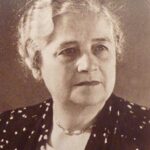
Joanna Millan
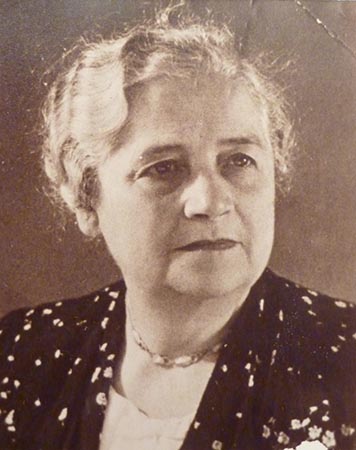
JM: Mother's mother Augusta Shaumach
Joanna Millan
Born: 1942
Place of Birth: Berlin
Arrived in Britain: 01/08/1945
Interview Number: RV162
Interview Summary
Date of interview: 15/12/2015
Joanna Millan was born Bela Rosenthal in August 1942 in Berlin. Her parents – Siegfried Rosenthal and Else Schallmach- had only met in 1941 but got married very soon after in order to be deported together. Joanna is one of the few child survivors of Theresienstadt, a fact she only found out later in life. She describes the process as a big jigsaw puzzle, that she gradually put together. Her father died in Auschwitz and her mother in Theresienstadt. Three of her four grandparents are buried in Weißensee cemetery Berlin and one grandmother died in Auschwitz. Once Yad Vashem digitised its database, she was contacted by a first cousin who shone a light on her father’s siblings and also told her personal stories about her father. Subsequently she found cousins from that side of the family all over the world (Australia, Brazil, USA). When she was put up for adoption, her mother’s sister in Lübeck was found and asked if she wanted to adopt Joanna, but the aunt declined. The aunt had survived the Holocaust because her Christian husband had protected her. After her aunt had died, Joanna got in touch with her daughter’s, Joanna’s cousins. She was able to build a relationship with them and has stayed in touch.
Joanna’s first memories are of being afraid on the plane taking her from the Czech Republic to England with other child survivors. Like her fellow interviewee, Jackie Young, she was first in Bulldogs Bank and then Weir Courtney. She has no memories of Theresienstadt but her memories from the time with the other children in England are astonishing clear for such a young age (three). She remembers how they looked after each other (e.g. if someone had nightmares) and how they were not interested in building relationships with grown-ups, who only featured as providers of food. As they led a hidden life in Theresienstadt without education or nurturing they had to learn the behaviour of normal children. Upon adoption, the parents changed her name and made it clear that neither the adoption nor her past were to be mentioned. Joanna remembers this as a double lie as she tried to keep the memory of her birth name and her identity alive. She wasn’t able to build a relationship with her adoptive parents who did not seem to enjoy parenthood. She received an education (including private school and a year in Paris), but grew up with a sense of loneliness as she couldn’t to talk to anyone about her experience – especially as people weren’t interested. She moved out as soon as possible and earned her own living as a secretary.
She met her husband in a Jewish youth group and they got married in 1964. Her children were born in 1965, 1966, 1967 and when they were older, she obtained a degree in business and ran a business selling musical instruments. Her husband was very supportive and gently pushed her to solve the mystery of her past. When she saw and advert in the Jewish Chronicle for volunteers to talk about the Holocaust in schools she called. An important aspect for her is to tell the students that people knew what was going on but made the decision not to resist.
She is convinced that her life experiences make her more understanding of other people’s background. This has been very helpful in her role as a magistrate which she has enjoyed for thirty-three years. She is secure in her British identity but she feels a real connection with her German relatives and their sense of humour. Her husband attributes her punctuality and her passion for straightforward discussions and debate to her German heritage. She is grateful for all the information she was able to find about her background and hopes to fill the remaining gaps.
Her message is to use every opportunity in life and that life is for living and for experiencing. Gather all the experiences you can – because this is really what life is about.
Keyword
Rosenthal. Schallmach. Berlin. Theresienstadt. Child survivor. Bulldogs Bank. Weir Courtney.
Place of Birth
But the behaviours we’d [the child survivors at Bulldogs Bank and Weir Courtney] learned in the camp we still continued. So that was quite interesting. You know, like the touching: we’d clearly seen dead bodies. When we were asleep we weren’t sure, so we checked each other at night just to- just to make sure. Other things. Getting used to having adults around. All we knew adults did was to bring food
behaviour child survivors
Everybody knew what was going on, and yet it wasn’t anything to do with them, somehow. You know that’s important, that we’re all responsible for each other. And the understanding that …by learning about it, by seeing how the absolutely unimaginable… horrors that happened…that you know, we, we learn how it was possible. How it was enabled, and you know the steps that were taken. We can stop, that it’s possible.
don't turn a blind eye
I mean obviously there’s an element of just being lucky. But yes, there were contributory factors certainly. That my mother had died in the camp. If she’d have survived, she would have been deported to Auschwitz and she would have carried me into the gas chambers. Because I had no one to take me; I was sort of ‘left’. Because why bother? You know, I’d die anyway. Also, I discovered, again through the internet, a woman – a Czech woman, Aliska Schillinger. Her son contacted me. He’d seen- I’d written a chapter in a book for Bet Shalom, and under my birth name. And apparently his mother had been looking for me, because she had wanted to take me home with her at the end of the war. But she wasn’t married. She was very young. Obviously just after the war, they didn’t know whether I had any family. They wouldn’t allow it. And apparently she’d been looking for me forever you know because she wanted to know what had happened to me. And her son contacted me and told me that her job in Theresienstadt was growing vegetables. You know, obviously for the Nazis. And the guards never realised that when she went in to the vegetable garden she was thin, and when she came out she was fat. And she was hiding vegetables in her clothes for herself obviously but also she brought us vegetables as well. So fresh vegetables were like gold dust in- in the camp. The food was so contaminated. If you ate it you died, and if you didn’t eat you died. So the fresh vegetables were the great life-saver. But I did meet her before she died.
How she survived as a three-year-old in Theresienstadt
So we [ child survivors] had constructive play I mean not just running around. And being outside. Even walking properly, because we hadn’t done much exercise. My legs were weak so we needed regular exercise. There was a swing in the garden. We went for walks in the bluebell woods.
child survivors exercise