
Leon Greenman
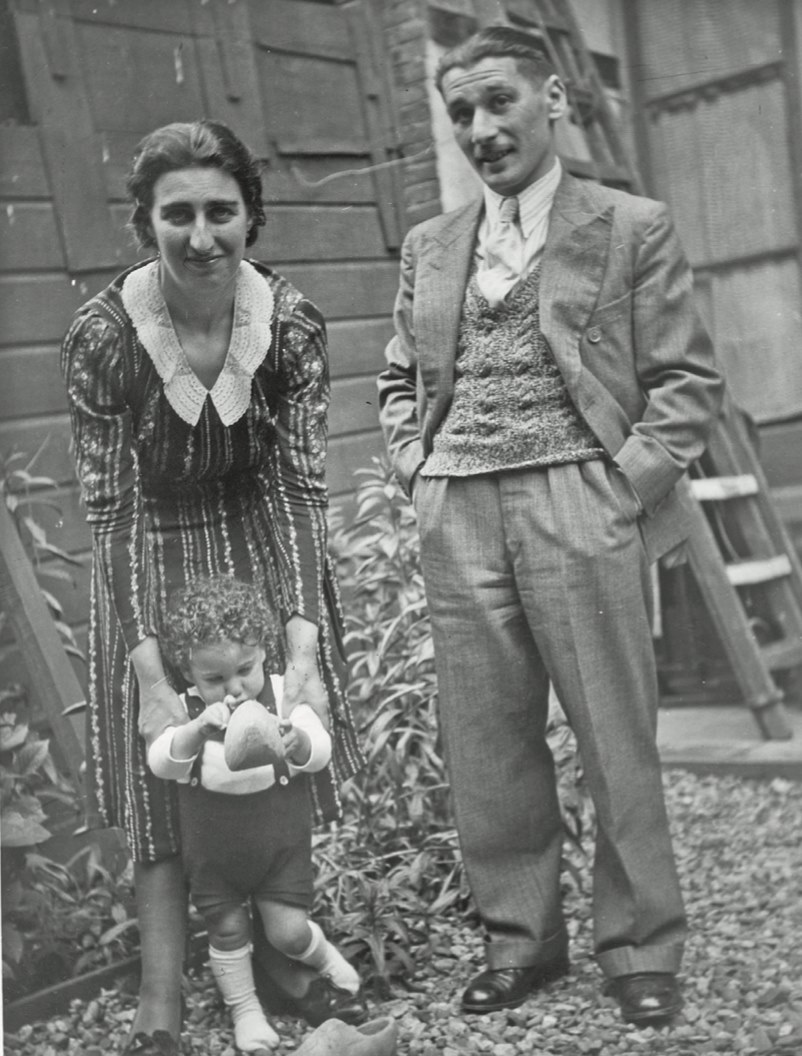
LG: With his family
Leon Greenman
Born: 1910
Place of Birth: London
Arrived in Britain: 20/01/2026
Interview Number: 71 (S)
Interview Summary
Date of interview: 20/08/2004
Leon Greenman (18.12.1910-7.3.2008) was born in Whitechapel, London, as one of six children. After his mother’s death he went to live with his father’s Dutch parents in Rotterdam. He trained as a boxer and returned to London where he became a barber. He married his wife Esther (“Else”) van Dam in 1935. Greenman joined his father-in-law’s bookselling business in Rotterdam. His son Barnett, known as Barney, was born on 17 March 1940.
Greenman and his family were arrested in 1942 in spite of the fact that he was a British citizen. Confirmation of his British citizenship arrived too late. The family were taken to Westerbork transit camp in Northern Holland in October 1942. Despite fighting for recognition of their British nationality they were deported to the death camp at Auschwitz-Birkenau in January 1943 where the family was separated. Greenman was one of very few Jews in Holland to survive transportation, slave labour and the notorious death march from Auschwitz. His wife and child were murdered in the gas chambers almost immediately after their arrival. Greenman became a slave labourer. Surviving another sorting after 6 weeks, he worked as a barber and sang to the prisoner functionaries (kapos) in the evenings. He later attributed his survival to his physical training and useful skills. He was transferred to Monowitz industrial complex inside Auschwitz (Auschwitz III) in September 1943, where he was subjected to medical experiments. When the camp was evacuated in January 1945, Greenman was sent on a 90-kilometre death march to Gleiwitz concentration camp and then taken in open cattle trucks to Buchenwald concentration camp. Following the liberation of Buchenwald by the U.S. Army on 11 April 1945 he went back to Rotterdam via Paris and moved to London in November 1945.
After the war Leon Greenman worked as a market salesman for 40 years and also performed as a tenor under the stage name of Leon Maure. As a survivor of the Holocaust he dedicated his life to educating the public about it and gave regular talks to school children about his experiences at Auschwitz. He gave many interviews including his first interview for the BBC whilst in hospital in Paris in April 1945. Westerbork Centre Museum developed a temporary exhibition on his experiences in the 1990s. Greenman donated photographs and mementos to the Jewish Museum in Finchley which opened a permanent gallery showing his collection in 1995. An accompanying book ‘Leon Greenman – Auschwitz survivor 98288’ was published in 1996 (also published under the title ‘An Englishman in Auschwitz’). The museum’s collection was merged with that of the Jewish Museum in Camden (now the London Jewish Museum). Upon reopening in 2010, Greenman’s items are shown in a permanent exhibition in the Holocaust Gallery. He also guided tours around the camp at Auschwitz.
Place of Birth
The Americans gave us thick soup, we couldn’t eat it, I could, I was always hungry. A lot of men didn’t eat. A lot of men died after they saw the liberation. I remember the Kapo of the barrack said to me ‘Come along, you can shave, you can cut hair, come along’. In that barrack were 42 men: beards and hair, for weeks they hadn’t been shaved. They were really in dirty condition. And they were ill, ready to be thrown away in the gas chamber, and nobody would have known. He said ‘clean them up!’ And the whole day I had to stand there, cutting their hair with a clipper. And shave them with a razor. Some of them couldn’t even sit in their chair. I had to hold them. They were Polish Jews. And I did that. And I can’t forget that.
Cutting hair after liberation, Buchenwald
...there was a day that the Americans unlocked the gates of Buchenwald, and thousands of men went out into the villages. Did the wrong things probably with the women. Chickens, radios, they came back with those things into the camp. And the public told the Americans. So the Americans said ‘no one is allowed out, and the gate is locked.’ No one is out. So I said to one of the Americans that came in then, I said ‘Look, I speak your language, I’m English, I didn’t go out with the group, I didn’t hurt people, I would like to talk to my men, you are my people, and I got a letter, I don’t know where it is, also in here somewhere: ‘This man has the right to leave the camp’. So whenever I wanted to go out, I showed the guard: ‘Here, I’m allowed to go out’. That’s how I used to mix with the Americans in the barracks, where I was, that’s one incident. Until the day came that… I got papers to leave and that was the 23rd, 24th of April, that I came out of the gates, I was walking on that road, I wanted to go back to Holland to do a bit of fighting, in my mind, I wasn’t weak but I wasn’t strong at all but I ? back, and asked an American: ‘Are you flying to Holland?’ ‘No, we don’t fly’, and on my walk, I thought to myself what’s the hurry? You’re free now, no more bullying, no more kicking’, and a jeep pulls up, and I heard a man say ‘Are you the man that wants to fly?’ I said ‘Yes, yes, that’s right, that’s me. Are you?’ He said ‘No, we’re not flying, but here’s a lady from London, England, she wants to talk to you. A lady from England who wants to talk? I hadn’t seen anybody from England for three years, and out of the Jeep came Anne Mattison. She was a journalist from the Evening Standard, in London, she came out and she talked to me, she said I want to know something, tell me something about the camps. I said “If you put my name and address where I used to live in England, in London so my brother and family in London can read that I’m still alive, if you put it in the papers, I’ll tell you”. And I told her, and she did. And a lady came running into my brother’s house and said ‘Look, isn’t this your brother?’ And it was, he read: ‘Leon Greenman, so and so, and so my brother knew that I was alive. And that was that, that was another incident. That article you can read, the Evening Standard, I think it’s Colindale, has libraries and you can see that you can find it, that article is in the Evening Standard of the 23rd, 24th of April ’45. Anne Mattison, and she gave the title on that: ‘The Barber of Buchenwald’. I wasn’t a barber in Buchenwald, but she used that for a journalist idea. But you can see that.
Talking to British journalist, Buchenwald
But I didn’t know about that, I didn’t want to believe it. But then that man who I helped now and then with the cement sacks, I used to say ‘Where is so and so?’ –‘Gassed’. –What do you mean gassed?’-‘ Gassed, finished with. Too weak to work’. –‘Ah, when you’re too weak to work, the gas chamber.’ Then I start believing it. But that didn’t happen to my wife and child. I didn’t want to believe it. It kept me alive. Somewhere my wife and child, was working, I’ll see her in the end, and we can talk to one another. There were only two occasions that I gave up this life… when I wanted to give up this life. I didn’t want to believe that my wife and kid were gone. I kept on living, and that, I was kidding myself, fooling myself, I didn’t want to believe the in and outs. I had fleas, I had lice, I had scurf, I was very hungry, I fought the hunger by shaving the beards of the prisoners, they had to be shaved every Saturday. So that’s what the Nazis said, when they march out to work on Monday, with a clean face. And who had to do the shaving, not the village barber, we, amongst the prisoners. Amongst the prison were ex-barbers like myself. And you shaved all day long, one was lathering, one or two others was shaving, and you got the shaver from the chief barber Kapo in the barrack, we had to hand that back, there’s another story in that. Anyhow. And for that you received payment. Not money. I never saw money in the camps. You got half a litre, if there was any left, half a litre soup on a Sunday. And if there wasn’t any, you didn’t get any, dare not to talk about it. If they want they’ll beat you up to ask you what you’re thinking, what did you say. You just took everything that came your way. Your former life did no more exist. You had a different life now. A terrible life.
Life in Auschwitz
Now the Chief Administrator in Westerbork was a German Jew. Kurt Schlesinger… Six foot tall, bald-headed, moustache, Hitler moustache. And in Westerbork a few times I approached him and told him ‘We’re British, get us out of here, put us in the hands of the Red Cross’. He never did… Now I wasn’t an electrician, I wasn’t a carpenter, I was of no use. So they gave me a job ‘Essenholer’it means getting up at five, or present yourself at five or quarter past five at the kitchen, collecting the milk for the babies, on a trolley and you hand out the milk to the babies in the camp. Oh, that’s alright, because I was working for my own people. OK. That went on alright and then I had one morning a mate of mine, in Westerbork, he said –‘Leon, he said, they picked up two hundred men in Rotterdam from the streets last night’. –‘Oh yes?’ And I thought of my father. And they’re in barrack 51, I think it was 51, the prison barrack, so I got out of my bunk early in the morning and I went to the prison barrack, I couldn’t get in, the doors were locked, nobody there. So I climbed up at the side of the barrack, opened the window and shouted my father’s name: ‘Barnard Greenman!’ Barney! And there was a lot of men there, smoke, smoking, and yes, after a few times, my father appeared. I said ‘Don’t leave the barrack, stay there tomorrow morning, I’ll come and see you in the morning and we’ll talk. And while I was talking, all of a sudden, I was pulled on my leg. And somebody, some voice I heard: ‘Wer ist das?’ Who’s this?, and the man who pulled my legs said ‘This is the Englishman’. And the voice of Kurt Schlesinger said: “Komm nach unten oder ich schicke dich nach Auschwitz!!” Come down or I send you to Auschwitz. That was Schlesinger. Caught me, standing there, that wasn’t allowed. And I shouted down to my father: “I’ll see you in the morning!” And I jumped down, which I can’t do now no more, and I stood in front of Schlesinger, and I said ‘Mr Schlesinger, you can’t send us to Auschwitz, because I’m British.’ Any moment it can be proved. He walked away. Some weeks after that, maybe three or four weeks, we were called up.
The Jewish Chief Administrator of Westerbork
The Americans were there, there was no-one to stop me from going into the barracks, and I went into various barracks and I saw the bunks, the things… they were empty, but then I went to a barrack and I saw Americans there, and laying in the bed, and I went there and I listened to what the Americans thought about, and I remember this young American was showing photographs of his family, to the other fellows. And I heard him say ‘I don’t know what I’m here for.’ And I looked at him, and I said to him: ‘Soldier, may I tell you that you saved my life’. And I told him who I was, and they were just in time to save our lives, what they did save. If he wouldn’t have come, if he had come tomorrow or next week, who knows we wouldn’t have been here. Then he understood. And on another occasion I was walking around in one of the barracks and I saw an American, he had a thing in his hands for eating and in there was a steak, a lump of steak, and he was looking around where to throw it or what, and I says, I said ‘Are you trying to throw this away the way you are looking?” –Yes, he says, it’s tough as the sole of my shoe’. I said well, sorry, I haven’t had a bit of steak meat here for three years, I’ve been a prisoner.’ He said ‘Do you want it?’ I said ‘Yes please’. And I ate the steak for the first time. And he said ‘Do you want any more?’ I said ‘yes, I’m still hungry’. So he took me along the road to the field kitchen of the Americans, and I had potatoes and some more food to eat. Ya, I remember all that.
Liberation of Buchenwald
Not everybody wants to talk about it. But I took an oath to God in Birkenau: if you can get me out I will tell the outside world what happened and I’m still doing it.
Talking about it
I sat there in a chair. I wasn’t there for half a minute, the door opens & in walks an SS officer. Beautiful uniform. Medals on his chest. He passed by, didn’t look at me, went to a window & then I heard him say ‘Anfangen’. Commence. The doctor tied my arms with leather straps to a chair. I had to spread my legs, they were tied with leather straps to the chair. I couldn’t move. They got a kind of tube with an instrument on there. They put it into my penis, turned it around, took it out & put it back again. I remember they pumped liquid into me. I let it go. The doctor said ‘Don’t let it go, hold it…’ So, they pumped it again & I held it. They were messing about with my body. I thought to myself ‘Ridiculous'. This went on for 10 minutes, maybe longer. I heard one doctor say ‘Das ist ein Engländer’. The SS comes to me, says in English ‘You’re British?’ ‘Yes, Sir I’m from London, I shouldn’t be here with my wife & child, can you get us out?’ ‘No, take your complaint to the political department. I’m the medical department.’ The doctors continued with me. They went so deep I thought ‘Aaah I can’t walk no more after this’, so I shouted out & he said ‘Lass’ ihn gehen, er braucht nicht wieder zu kommen’. They unstrapped me, took me back to barracks. For the whole week, when I had to pee, blood came.
Medical experiments at Auschwitz