
Lilian Levy
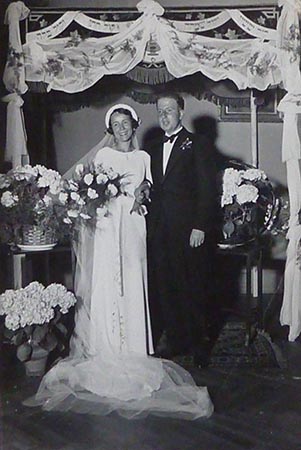
LL: Parents on their wedding day
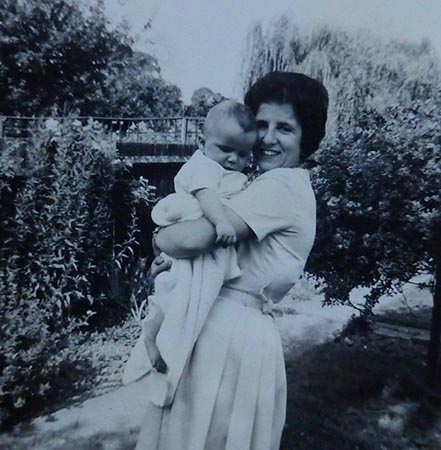
LL: With first-born son
Lilian Levy
Born: 1939
Place of Birth: London
Arrived in Britain: 20/01/1946
Interview Number: RV164
Interview Summary
Date of interview: 16/01/2016
Lilian’s parents Hedrich and Adolf Dreifuss lived in Frankfurt a/M, where her father had a silverware factory in nearby Hanau. He was arrested on Kristallnacht and imprisoned for several weeks. When he was released, her parents fled to Amsterdam. They managed to get visas to the UK and came in the summer of 1939 and therefore Lilian was born in August 1939 at the Royal Free Hospital, London. Her father returned to Amsterdam to sort out his business interest and her mother and herself followed him. They took the last plane from the UK to Holland before the outbreak of WW2 (on 31 August).
The family lived in Amsterdam until they went into hiding. In 1943, the family decided to come out of hiding because they thought that Lilian’s British citizenship, would allow the entire family to relocate to Britain. But instead, they were deported to Westerbork and in late 1943 to Bergen Belsen. Lilian stayed with her mother in the ‘Stern Lager’ (star camp). Lilian remembers that she was told that her mother had died and that some people took care of her. Only in the early eighties did she find out that a Mr Birnbaum and his wife took the Dutch orphans under their wing and even managed to organise a small ‘school’ in Belsen. Lilian was liberated in Troebiz and put into an orphanage in Laaren, Holland. In January 1946 Lilian arrived in the UK to be reunited with her aunt.
After a few months in the UK, Lilian was adopted by an elderly German Jewish refugee couple, Frieda and Heinz Davidson (he was a pediatrician in Germany and re-sat his medical exams and became a GP in the UK). The couple had already one grown-up daughter, who was a dentist in London. Lilian grew up in Swiss Cottage and went first to South Hampstead Junior School and then Parliament Hill Grammar school. Her aunt kept in touch with her and took her every Friday night to the Liberal Jewish Congregation (later known as Belsize Square Synagogue), founded by German Jews in 1939. The then rabbi of the Synagogue, Rabbi Dr Georg Salzberger, had married her birth parents before the war in Frankfurt. Lilian found a home in the synagogue, especially in the Youth Theatre Programme, called the Phoenix. She met her future husband, Herbert Levy, in the Phoenix, when he became its leader.
They married in 1961 and settled first in Hendon and then in Golders Green and had two children. Lilian helped her husband in the wholesale hosiery business and they stayed very active members of Belsize Square Synagogue. Lilian found out a lot about her history when her aunt passed away in 1981 and they found all the war and post-war correspondence she had kept. Lillian managed to trace Mr. and Mrs. Birnbaum (who took care of her in Belsen) in Israel and they had a reunion in Israel.
Lilian’s husband Herbert became one of the main guides for the Anne Frank Trust. While Lilian supported him, she could not manage to talk about her history and still finds it very painful to recall her past.
Additional Comments:
Key words: Dreifuss. Allerhand. Frankfurt a/M. Amsterdam. Bergen-Belsen (Star Camp- Stern Lager). Birnbaum – Dutch orphans. Westerbork. Troebiz, Orphanage Laaren. Adoption. Belsize Square Synagogue. South Hampstead Junior School. Parliament Hill Grammar School. Anne Frank Trust.
Place of Birth
Well I’ve so often heard, “Let it never happen again.” But it does. It keeps happening again, wherever it is, all over the world. And… So I suppose it ought to be talked about. But even with all the talking that one does it does happen again. I think human nature must be pretty awful to let these things happen all the time. At the moment we have a refugee situation coming from the Middle East, Syria and so on. And I think peoples’ reactions have been less than warm and whole-hearted. I think we could afford to be more accepting, and perhaps that is my own view, or perhaps it’s because of my own experience. I’m not quite sure which. But I just wish we could be more receptive to other people who have trauma and need us.
the legacy
And we went into Belsen, and my father was separated from us, and I was with my mother. And I do remember various things about the so-called washing arrangements. Showers which I don’t remember really using more than about once or twice. I certainly remember the food… what there was of it. It was dreadful. It was water, a turnip boiled in water, and that was known as a soup. And this one piece of turnip, and a piece of black bread - very hard. And that was the day’s ration. My parents gave me theirs. It wasn’t enough to keep body and soul together, but I took theirs because I was hungry and I didn’t know any different. And… they starved to death. My father in December ‘44 and my mother in January ‘45.
Starvation in Bergen-Belsen
Nobody talked about anything after the war. My adoptive parents took the attitude that they didn’t want to remind me of bad things and of hard times. And they didn’t ask anything at all. And I was and is okay about that really, but I did want to know what had happened. I didn’t want to tell my memories; I wanted to have my memories fleshed out.
not talking about it post war
I was in the barracks for the women. They did have a so-called hospital barrack, which my mother was put into when she was - because not only was she starving to death, she also had breast cancer for the second time. And I remember sitting by her side… just being with her, until I was taken away because - she was no more. I remember the staff were… pretty awful to her. Brutal, because she was no longer continent, and there was a mess everywhere. I can’t see that it mattered; the mess was terrible anyway. But I remember her being told off. That would strike a child. I was then six. No sorry, I was…I was five. I was five at that time. The washing facilities, so-called, we were terrified of those showers, the children. Because people had come from all over the place including Auschwitz, and word had got round that the showers did not give off water; they gave off gas. Well that wasn’t the case in Belsen, but the word went round. I’m sure there were a lot of awful rumours all the time, and I had a deep fear of those showers.
fear of showers
My mother-in-law, Herbert’s mother, had …had happy memories of Germany, because she was born in 1900, and wanted to go back to visit. So, the first time that we really went back was when she wanted to go and she was too old to travel alone. And we went with her. You asked me whether I had been to Frankfurt. That was the only time I went to Frankfurt. And, on our way to Bad Orb, which is a spa near there. And it was near enough after the end of the war for there still to be people around, who would have been active during the war. And all these people strutting around the spa town, taking their daily constitutional, it didn’t take much imagination to see them goose-stepping actually. Herbert and I were really quite appalled, and well, felt very uncomfortable there. We had actually been before to Germany. That was the only time we went to Frankfurt. But he had a cousin, who lived in Germany, in Berlin, in East Berlin. And… they couldn’t come to England, she and her family. So, we went to visit them. And… we crossed over, went to the West and crossed over at Friedrichstraße or Checkpoint Charlie or one of those. And stayed with them for the day and then came back to West Berlin at night. And… we very much enjoyed being with them. But not with all the people that one sits next to in the train at that time. You just didn’t know who it was. Well, that carried on like that, until about 1994. And at that point, Herbert had reached retirement age, and was doing voluntary work with Anne Frank Exhibition; he was the principal guide for them. The Anne Frank Exhibition took a volunteer from Aktion Sühnezeichen Friedensdienste – Action Reconciliation Services for Peace - a very cumbersome name, but a very wonderful organisation that had young volunteers at that time avoiding military service. They didn’t want to do conscription, but they had to do some kind of voluntary service of some kind. And they joined this organisation and were sent to countries that had formerly been affected by the Nazi era. That included Israel, even though Israel hadn’t existed at the time. This ASF, this group of young people, they had a volunteer always at the Anne Frank Exhibition. And from 1994 onwards, Herbert met these youngsters, and he brought some of them home. And… we made friends with them, and told ourselves that we were being silly about Germans today. What- These people in 1994 were aged twenty. What responsibility did they have? Even their parents, were kids, at the time. Just don’t ask about the grandparents. …And we made friends with them, and gradually we acquired a whole host of nice young people some of whom are still friends today. And I really feel that through this organisation, through ASF, they – they have given me a clearer sense of how to be with German people, and have released me from a lot of problems that I had with anything to do with Germany. And my relations are much more normal now. I can- I’ve been on holiday in Germany. Herbert and I went on a cruise down the Rhine, which was very nice. And… it’s just a regular, normal relationship now.
returning to germany
There was one man in there, a Mr Birnbaum, Mr Birnbaum who had been a teacher in Berlin. He was in Belsen with his wife and his six children. And as the war was progressing and in fact reaching its end and people were dying left right and centre, he gathered orphans as they became orphans. And my father, realising that he wasn’t going to survive… went to see this Mr Birnbaum and asked him to look after me and after the war to get me to his sister-in-law, my aunt in London. And he gave as many details it could. He also gave him a book of addresses and names, and… apparently they took that from Birnbaum; he never had it. So after the war he had a lot of difficulty finding… relatives for people, including for me. And… this Mr Birnbaum was very worried about all these children; he had by this time about fifty children in his care. Six of them were his own children and the rest of us were orphans. And he went to the authorities in the camp, and said that he would like to start a school. School. And they mockingly said, “Yeah, sure, you do that. You can have your school in the room at the end of that barracks there. But you have to clear it first.” He didn’t know what that meant. So he went to look and he saw that that’s where corpses had been stored, piled high, because they couldn’t be buried quickly enough. And so they were just put in there until burial could be organised. So he organised a work party amongst the inmates, and they cleared that room. And we fifty children had our schoolroom in there. And I remember that he taught us- He’d been a teacher of religious instruction in Germany, in Berlin. And he taught us Jewish studies and my time in Belsen was approximately the most religious time of my life, I would say, which is quite an irony. But it kept us out of harm’s way, because we were locked in there, and couldn’t get under the feet of guards, who - who would shoot or set dogs on people if they felt like it.
Mr Birmbaum in Bergen-Belsen