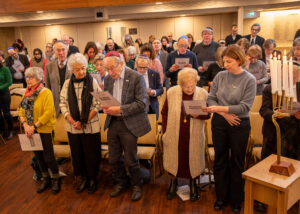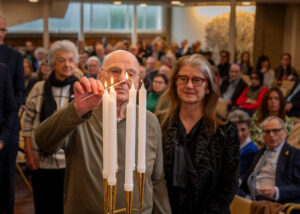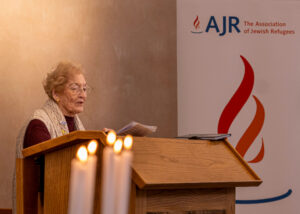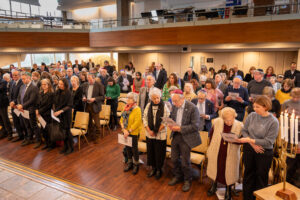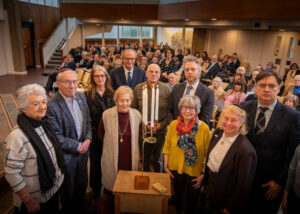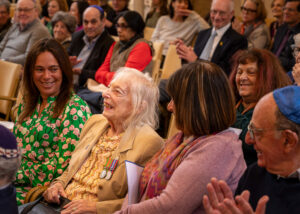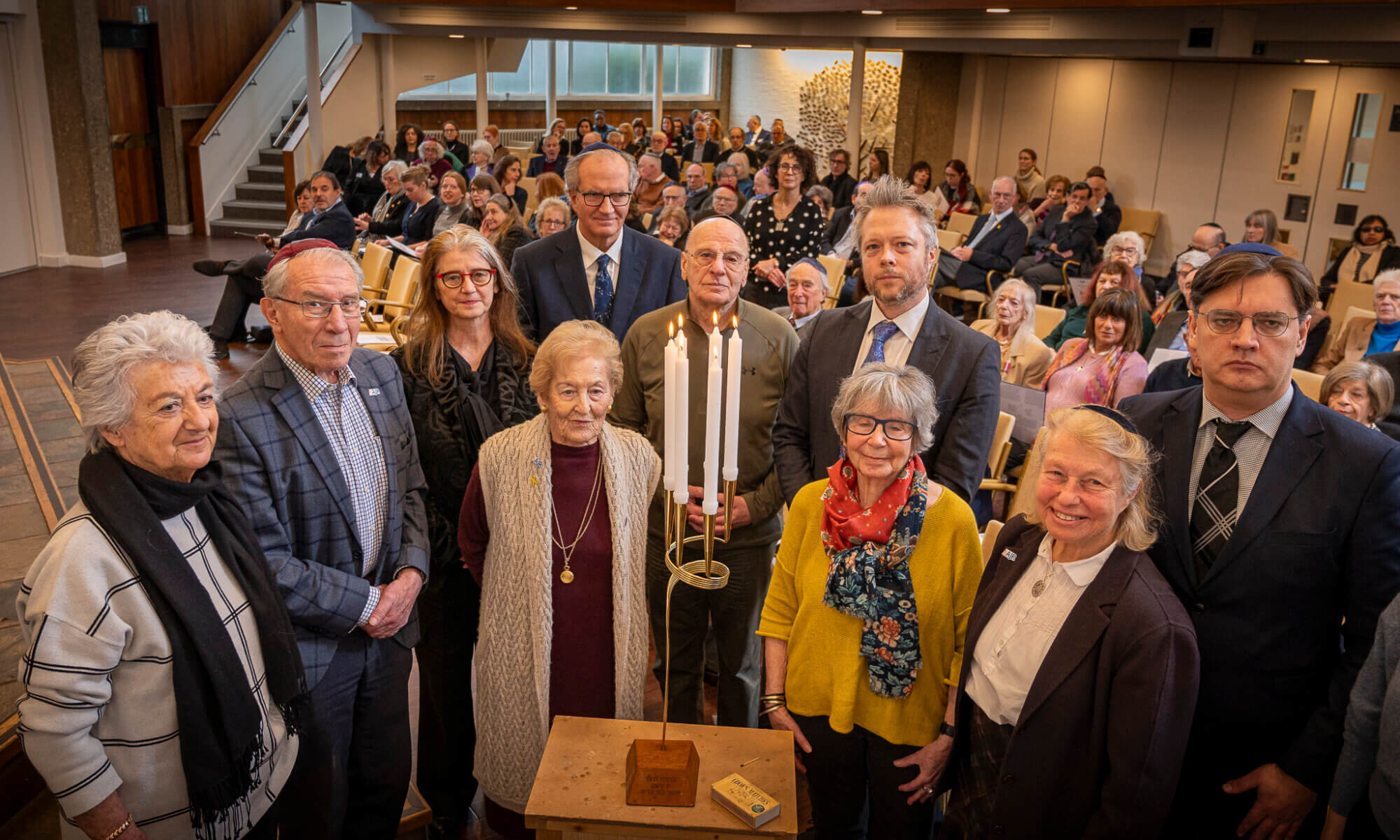
The Association of Jewish Refugees (AJR) today held its annual Holocaust Memorial Day service, remembering those who were murdered by the Nazis and those who suffered at the hands of Nazi terror. The service took place at Belsize Square Synagogue, in North London and was officiated by Rabbi Gabriel Botnik and featured vivid accounts of the Shoah.
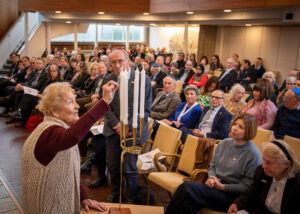
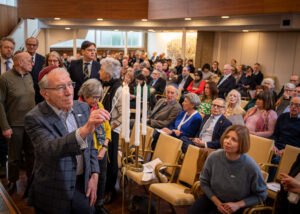
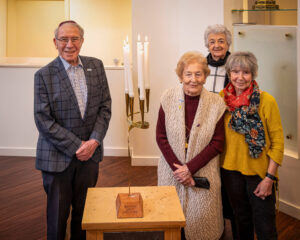
Photography by Adam Soller Photography The theme of HMD 2025, ‘for a better future’, is especially relevant as this year marks the 80th anniversary of the liberation of Auschwitz. The event had additional poignancy, this year, at a time when Jews around the world and society are facing increasing antisemitism and Holocaust distortion and where the remaining living witnesses rely on us, more than ever, to carry forward their legacy in the hope of ending future suffering and prejudice. Auschwitz-Birkenau has become a symbol of the horrors of the Holocaust. It was established in 1940, in the suburbs of Oswiecim, a Polish city that was annexed to the Third Reich by the Nazis. Auschwitz existed because mass arrests of Poles were beyond the capacity of existing ‘local’ prisons. It b ecame the largest of the extermination camps where the ‘Endlösung der Judenfrage’ (the final solution to the Jewish question – the Nazi plan to murder European Jews) was carried out. Speakers included AJR member, Mindu Hornick MBE, who miraculously survived Auschwitz. Mindu’s powerful testimony reflected on one of the darkest chapters of humanity: “I remember looking back. I couldn’t see my brothers because of the crowds, but I caught sight of my mother. She was wearing a spotted scarf. I was able to wave to her and she waved back. That was the last time we saw her. When we went through that main gate we entered hell. There were watchtowers and machine guns pointed at us, and all along the side there were skeletons just covered in skin on trollies, and men in their striped clothing, walking around dragging these trollies, and others just walking around aimlessly. And there was a terrible smell, and a grey ash falling. We didn’t know what it was, but it felt greasy. What we saw was just unbelievable. It was the vision of hell” Read Mindu’s My Story book here. During the proceedings, six AJR Holocaust survivors and refugees illuminated memorials in a moving candle lighting ceremony and memorial prayer in remembrance of the six million Jewish people murdered by the Nazis and their accomplices. In his remarks, AJR CEO Michael Newman reflected on the vital importance of remembering the victims of Nazi terror, as well as the launch of two groundbreaking resources the charity has built in a climate of rising Jewish-hatred and diminishing numbers of living witnesses: “As the national organisation representing and supporting Holocaust refugees and survivors, the AJR is acutely sensitised to the critical need to perpetuate the history and experiences of our members. Hearing Mindu’s account of the horror of Auschwitz and disseminating the resources we have built, including The Holocaust Testimony UK Portal and 80 Lives/ 80 Objects exhibition, will help combat increased antisemitism and s tem Holocaust distortion, as we all look to secure ‘a better future’ for society, the theme of this year’s Holocaust Memorial Day” The Holocaust Testimony UK Portal is a collection of collections, an interactive and easy to use archive of those who experienced Nazi oppression that brings together testimonies taken over many years by varied and leading institutions. The 80 Lives/ 80 Objects exhibition presents 80 objects from filmed testimonies of Holocaust survivors and refugees, who settled in the UK. The 80 artefacts, photographs, documents and everyday items, create a tangible link to the lives of each t estimony giver; to the before of a disrupted past and the traumatic experience of discrimination, exclusion, emigration, and survival. The objects are the carriers of memory and they connect the interviewees to lost communities, lost family members, and lost possessions and/or to specific moments in their own life journeys. Guests of honour included The British Envoy for Holocaust and Post Holocaust Issues Lord Pickles and representatives from the German, Austrian and Ukrainian Embassies in London as well as representatives from organisations with which the AJR works closely.